
UK Firms in Africa: Strategic CEMAC Expansion Resource

What if the greatest barrier to your African expansion isn't the geographical distance, but the strategic gap between your UK boardroom and your regional operations? Many UK leaders recognise that whilst Gabon and Cameroon offer untapped commercial frontiers, the lack of trusted on-the-ground representation often creates a sense of profound uncertainty. It's natural to feel concerned about regulatory shifts or cultural misalignments that can quietly derail even the most robust strategy. This is not merely a management challenge; it's a call for a more refined approach to leadership in unfamiliar territories.
This resource provides a definitive framework for project direction for UK firms in Africa, designed to transform these regional complexities into clear competitive advantages. By mastering the intricacies of Central African market entry, your organisation can move beyond survival toward sustainable, risk-mitigated growth. We will explore how to navigate the CEMAC regulatory landscape, establish robust oversight protocols, and bridge cultural divides to ensure your expansion is both profitable and culturally resonant.
Key Takeaways
Distinguish between tactical management and strategic oversight to maintain boardroom control whilst aligning local operations with your core UK corporate objectives.
Identify high-growth opportunities within the CEMAC region, specifically focusing on the untapped potential of sustainable tourism and global trade in Gabon and Cameroon.
Implement a structured five-step framework for project direction for UK firms in Africa to ensure a logical progression from initial market intelligence to sustainable commercial execution.
Navigate the complexities of the OHADA legal framework and regional regulatory requirements with a grounded, risk-mitigated approach to compliance and investment security.
Leverage over twelve years of on-the-ground mastery to bridge cultural and linguistic gaps, fostering long-term trust between British leadership and Central African operational teams.
Table of Contents
Understanding Project Direction in the African Context
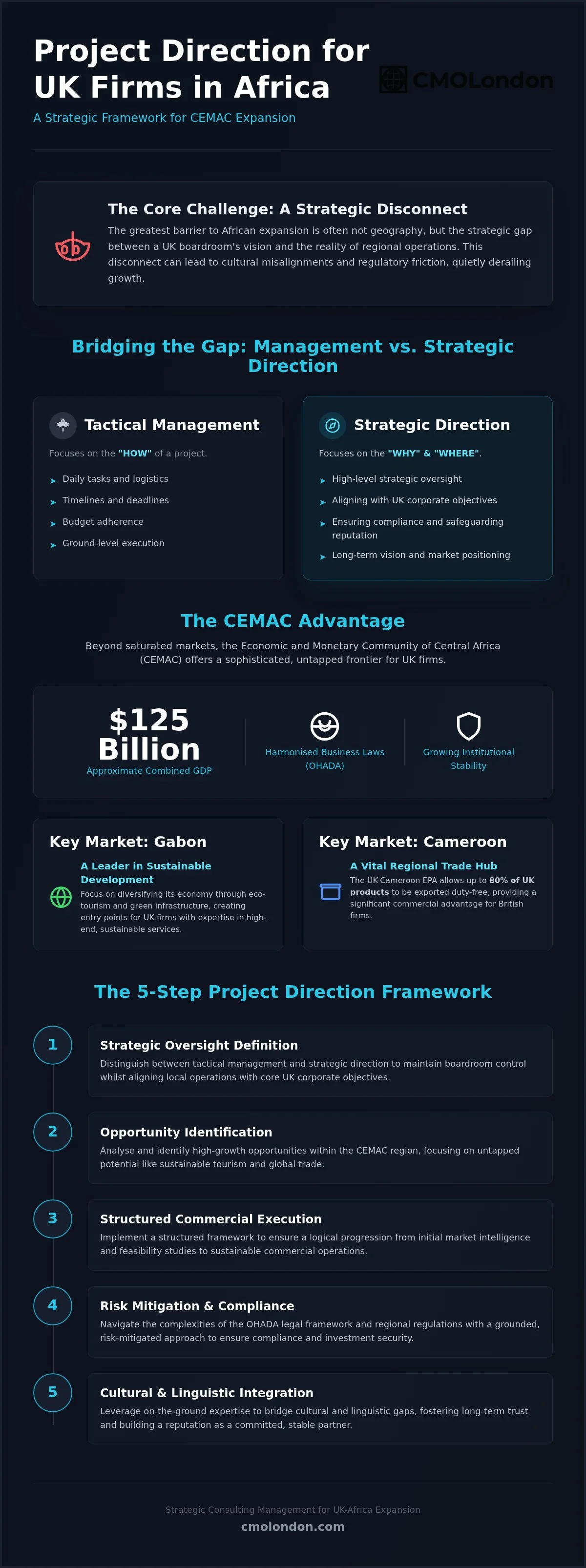
Project direction isn't just another layer of management; it's the strategic compass that ensures every operational step on the ground mirrors the vision established by your UK-based leadership. Many firms approach African expansion as a series of administrative hurdles to clear. They focus on logistics, local hires, and office space whilst losing sight of the overarching "why". This detachment often leads to a misalignment where local activities don't actually support long-term corporate goals. Effective project direction for UK firms in Africa requires a "Strategic Bridge" that connects high-level intent with regional reality.
Expansion frequently falters when boards treat it as a purely administrative task. They might hire a talented project manager to handle the "groundwork" but fail to appoint a project director who can translate parent-company priorities into actionable local strategies. This gap creates a vacuum where cultural misalignment and regulatory friction thrive. By prioritising project direction for UK firms in Africa, organisations ensure that their expansion isn't just a venture, but a sustainable extension of their global identity.
The Distinction Between Management and Direction
Management is concerned with the "how" of a project: the daily tasks, timelines, and budgets that keep things moving. Direction, however, focuses on the "why" and "where". It provides the high-level oversight necessary to maintain UK compliance standards and safeguard a firm’s reputation amongst international stakeholders. Without this boardroom-level perspective, projects in the Economic and Monetary Community of Central Africa (CEMAC) can easily drift into regulatory non-compliance or cultural irrelevance. A director doesn't just watch the clock; they watch the horizon.
The Cultural Intimacy Factor
Success in Francophone Central Africa demands more than just a translated business plan. It requires a profound level of cultural intimacy that moves beyond surface-level networking. UK firms often struggle because they lack a "cultural translator" at the executive level; someone who understands the subtle social nuances and linguistic intricacies of markets like Gabon or Cameroon. True mastery involves building a deep-rooted regional presence based on mutual respect and shared values. It isn't enough to simply be present. You must be perceived as a stable, committed partner who understands the local heartbeat and values long-term trust over short-term gains.
Evaluating the Strategic Landscape: The CEMAC Advantage
While many UK boards default to the familiar landscapes of Nigeria or South Africa, the CEMAC region represents a sophisticated alternative that remains largely untapped. This zone offers a combined GDP of approximately $125 billion. It's a region where the traditional perception of risk is often disconnected from the modern reality of harmonised business laws and growing institutional stability. The UK-West and Central Africa Trade and Investment Forum recently highlighted this shift, signalling a new era of engagement for British interests. Effective project direction for UK firms in Africa ensures these opportunities aren't lost to a lack of local nuance.
UK firms that look beyond saturated markets often find that Central Africa provides a more welcoming environment for long-term partnerships. The region's commitment to economic integration offers a structured framework for expansion that rewards those who arrive with a clear, informed strategy. For those seeking to navigate these waters, strategic consulting management provides the necessary clarity to distinguish between perceived threats and genuine operational complexities.
Key Markets: Gabon and Cameroon
Gabon is rapidly emerging as a leader in sustainable development, moving purposefully to diversify its economy through eco-tourism and green infrastructure. Its focus on preserving natural capital creates a unique entry point for UK firms with expertise in high-end, sustainable services. Meanwhile, Cameroon serves as a vital regional hub. The UK-Cameroon Economic Partnership Agreement, ratified in 2021, provides a significant advantage by allowing the UK to export up to 80% of its products duty-free. These specific nations have become favourites for sophisticated investors who value the intersection of legal predictability and high growth potential.
The Role of Global Trade and Sustainable Tourism
Sustainable tourism projects in the CEMAC zone do more than just attract visitors; they act as a vital catalyst for wider infrastructure growth. A single luxury eco-lodge project can necessitate improvements in local logistics, digital connectivity, and supply chain reliability. Aligning these commercial outcomes with a firm’s broader values, such as early childhood development, fosters deep-rooted trust with local communities. By utilising rigorous Business Process Management, firms can ensure their operations are efficient whilst creating value that transcends simple profit. This holistic approach to project direction for UK firms in Africa transforms a standard market entry into a meaningful, sustainable legacy within the region.
The Project Direction Framework: From Strategy to Execution
Moving from a strategic vision to on-the-ground execution requires a methodical approach that respects both UK corporate standards and Central African operational rhythms. A robust framework for project direction for UK firms in Africa provides the necessary structure to bridge these two worlds. It's about creating a steady, purposeful progression that ensures every decision is informed by rare, local insights whilst maintaining the high-level control required by a British board. This framework transitions your leadership from a state of uncertainty toward a state of mastery.
Execution in the CEMAC region isn't a race; it's a disciplined journey. By following a structured five-step process, firms can ensure their expansion is both resilient and adaptable. This methodology relies on a context-then-solution approach, where we first acknowledge the regional complexities and then apply sophisticated management principles to navigate them.
Step 1 & 2: Market Entry and Strategic Alignment
Success begins with a deep-dive market analysis that transcends standard industry reports. We look for cultural and linguistic nuances that raw data often misses. This initial phase of Strategic Consulting Management identifies the subtle shifts in local sentiment that can impact project longevity. Step 2 focuses on strategic alignment, ensuring the African venture complements the parent firm’s broader Life Strategy Services. We identify key local stakeholders and establish government relations early, building the long-term trust necessary for sustainable growth. This alignment ensures the project remains a core priority rather than a peripheral experiment.
Step 3 & 4: Operational Oversight and Risk Mitigation
Step 3 establishes bespoke project direction protocols for remote operations, creating clear lines of communication between the UK HQ and the Central African team. Step 4 implements rigorous Business Process Management to optimise operational efficiency. This includes navigating specific regional constraints, such as the BEAC limit of XAF 1 million per user, per month, on international online payments. Any amount exceeding this requires written authorisation from the BEAC, a detail that requires proactive planning to avoid liquidity bottlenecks. Monitoring KPIs whilst respecting local business rhythms ensures that progress is measured accurately without causing cultural friction.
Step 5: Continuous Leadership Development
The final step focuses on the human element of leadership. Personal Coaching is utilised to prepare UK executives for the high-stakes negotiations and unique social dynamics of markets like Gabon and Cameroon. This development ensures leaders maintain the "Wise Guide" perspective throughout the project lifecycle. By investing in leadership maturity, firms ensure they have veterans who can lead others through difficult paths with integrity and dedication. This stage transforms individual managers into sophisticated bridge-builders who value mutual understanding as much as commercial success.
Mitigating Risk and Ensuring Compliance in Central Africa
The primary concern for any UK board considering the CEMAC zone is the security of their investment. Is our capital safe? In reality, Central Africa provides a surprisingly robust legal framework through the Organisation for the Harmonisation of Business Law in Africa (OHADA). This system offers a level of predictability that is often overlooked by those focusing solely on more saturated markets. However, a framework is only as effective as the oversight managing it. Dedicated project direction for UK firms in Africa acts as the vital safeguard against regulatory slippage, ensuring that local operations remain fully aligned with both regional laws and UK compliance standards.
Building trust in this region requires more than just legal adherence; it demands a visible commitment to transparency. Our twelve years of on-the-ground mastery allow us to navigate these complexities with a steady hand. If you are ready to secure your expansion with expert oversight, consider our Project Direction services to bridge the gap between London and Central Africa.
Understanding OHADA and Local Regulations
OHADA provides a unified commercial code that simplifies business registration and contract enforcement across the region. For British firms, this means operating within a system designed to protect commercial interests. Compliance, however, remains a moving target. For instance, companies in Cameroon must meet the new Personal Data Protection Law requirements by 23 June 2026. Professional project direction ensures these deadlines are met whilst managing other fiscal obligations, such as the 0.2% African Integration Contribution tax on imports. Avoiding registration pitfalls requires more than a checklist; it requires cultural and linguistic fluency.
Ethical Investment and Social Impact
Long-term stability in Gabon or Cameroon is inextricably linked to a firm’s "social licence to operate". We believe that commercial growth should not exist in a vacuum. By integrating social initiatives, particularly those focused on early childhood development, firms build deep-rooted trust within local communities. This values-driven strategy transforms a project from a foreign venture into a local asset. Effective project direction for UK firms in Africa ensures these initiatives are not mere afterthoughts but are woven into the core business process management. This holistic approach mitigates social risk whilst fostering an environment where sustainable growth can flourish.
Partnering for Success: Why CMOLondon is Your Strategic Bridge
CMOLondon stands as a veteran presence in the CEMAC region, offering a level of cultural and linguistic fluency that is rare amongst international consultancies. Led by Elizabeth Traore-Andony, who brings over 12 years of specialist experience in Gabon and the wider Central African zone, our firm acts as the definitive bridge between British corporate ambition and African commercial reality. We don't just offer advice; we provide the steady, grounded leadership necessary to ensure your expansion is both resilient and sustainable. By choosing expert project direction for UK firms in Africa, you aren't just hiring a consultant; you're partnering with a wise guide who has already navigated the paths you now seek to tread.
The complexity of the African market requires more than a standard management approach. It demands a partner who possesses deep-rooted stability and an intimate understanding of local social nuances. We translate high-level strategic intent into actionable, on-the-ground operations, ensuring that the values of your UK board are never lost in translation. This alignment is what transforms a risky venture into a masterful commercial success, allowing you to lead with the confidence of a seasoned veteran.
Bespoke Advisory for Elite UK Firms
Every industry carries its own set of intricacies, from the specific logistics of sustainable tourism to the regulatory demands of global trade. We tailor our Project Direction to meet the precise needs of your organisation, providing access to on-the-ground insights that standard market reports simply cannot capture. By managing the complexities of the bridge, we allow your leadership team to focus on what they do best: driving growth and innovation. Our role is to ensure the path remains clear, the risks are mitigated, and the reputation of your firm remains beyond reproach amongst regional stakeholders.
Next Steps: From Potential to Mastery
Transitioning from a state of uncertainty to one of clarity begins with a purposeful conversation. When you initiate a partnership with CMOLondon, the first phase involves a deep-dive Strategic Consulting Management session. We'll examine your current objectives, identify potential regional friction points, and begin the process of aligning your corporate goals with the realities of the CEMAC zone. This methodical progression ensures that no step is taken without informed confidence. Secure the future of your expansion and move toward a state of commercial mastery.
Enquire about our Project Direction services today to begin your journey into the Central African market with a trusted veteran by your side.
Securing Your Legacy in the Central African Market
Expanding into the CEMAC zone is a journey that rewards the prepared. Success depends on moving beyond tactical management to embrace high-level oversight. By understanding the OHADA legal framework and respecting local cultural rhythms, your firm can transform perceived risks into a clear competitive advantage. Mastering project direction for UK firms in Africa ensures that your boardroom's vision is accurately reflected in every operational milestone across Gabon and Cameroon.
CMOLondon provides the rare, on-the-ground insights needed to navigate these intricate markets with confidence. With over 12 years of Central African market experience and specialist expertise in OHADA regulations, we offer the bespoke strategic consulting your board requires to build a sustainable legacy. It's time to bridge the gap between London and Central Africa with a partner who values long-term trust as much as commercial growth. Contact CMOLondon to discuss your African Project Direction and secure the future of your expansion. The path to mastery starts with a single, informed step.
Frequently Asked Questions
What is the difference between project management and project direction for African ventures?
Project direction for UK firms in Africa focuses on strategic oversight and boardroom alignment, whereas project management handles tactical, daily logistics. Direction ensures that every local operational step mirrors the high-level vision and corporate goals established in the UK. Whilst a manager handles the "how" of a project, a director focuses on the "why" and "where". This distinction is vital for maintaining boardroom control and ensuring long-term commercial success in complex markets.
Why is the CEMAC region particularly attractive for UK firms in 2026?
The CEMAC region offers a combined GDP of approximately $125 billion and remains a sophisticated alternative to more saturated African markets. With the UK-Cameroon Economic Partnership Agreement now fully ratified, British firms can export up to 80% of their products duty-free. Additionally, Gabon’s purposeful shift toward sustainable tourism and green infrastructure creates unique entry points for elite UK organisations that value stable, long-term partnerships over short-term gains.
How does CMOLondon handle the linguistic and cultural barriers in Francophone Africa?
We bridge these gaps through deep-rooted cultural intimacy and total fluency in the social nuances of Francophone Central Africa. Our twelve years of on-the-ground experience allow us to act as a "cultural translator" at the executive level. This involves more than simple translation; we navigate the unwritten codes of business etiquette and social hierarchy. We ensure your leadership team communicates with the grace and respect required to build enduring trust.
What are the primary regulatory hurdles when entering the Gabon or Cameroon markets?
Entering these markets requires navigating the OHADA legal framework and specific regional mandates, such as Cameroon's Personal Data Protection Law deadline on 23 June 2026. Firms must also manage BEAC restrictions, including the XAF 1 million monthly limit on international online payments without prior authorisation. Effective project direction for UK firms in Africa anticipates these requirements, ensuring that administrative bottlenecks don't interrupt commercial momentum or lead to costly non-compliance.
Can CMOLondon assist with existing projects that are currently underperforming in Africa?
We revitalise struggling ventures through rigorous Business Process Management and Strategic Consulting Management audits. Underperformance often stems from a disconnect between UK strategy and local operational reality. We identify these friction points, whether they are cultural misalignments or inefficient workflows, and implement a corrective framework. By providing the necessary strategic oversight, we help boards regain control and steer their African operations back toward sustainable growth and commercial mastery.
How does the firm integrate social impact into commercial project direction?
Social impact is woven into our core strategy through initiatives focused on early childhood development. We believe that building a "social licence to operate" is essential for long-term project stability in nations like Gabon. By investing in local community welfare, firms build deep-rooted trust that transcends simple commercial transactions. This values-driven approach mitigates social risk and ensures your expansion is perceived as a meaningful partnership that benefits the entire region.
What role does executive coaching play in international expansion?
Personal coaching prepares UK leaders for the high-stakes environment of Central African business. It equips executives with the psychological tools needed to navigate unfamiliar negotiation styles and cultural behaviours. This development ensures that leaders maintain a "Wise Guide" perspective, allowing them to lead with integrity whilst managing the pressures of expansion. By maturing the leadership team, firms ensure they have veterans capable of building stable relationships across different worlds.
Is CMOLondon able to facilitate government relations within the CEMAC zone?
Our long-standing presence in the CEMAC zone allows us to facilitate constructive dialogue with local authorities and government bodies. We understand the methodical rhythm of regional governance and the importance of building trust-based networks over many years. This expertise ensures your project aligns with national development goals, reducing the risk of regulatory friction. We act as your sophisticated bridge-builder, ensuring your firm is respected as a dedicated and values-driven partner.