
Political Risk Analysis in Central Africa: A Strategic Framework for 2026

What if the greatest threat to your 2026 expansion into the CEMAC zone isn't a sudden change in leadership, but a subtle shift in a digital permanent establishment threshold or a new local content mandate? You likely recognise that Central Africa offers some of the most compelling growth potential on the continent, yet the fear of sudden regulatory shifts and security uncertainties in non-urban areas remains a persistent weight on your strategic planning. Navigating the intricacies of OHADA law and CEMAC-specific frameworks often feels like a daunting task for even the most seasoned international executive.
We believe that clarity is the most valuable currency in these markets. This article provides a sophisticated framework for political risk analysis Central Africa, designed to transform these complexities into a structured, manageable roadmap for informed decision-making. You will gain access to a clear risk-rating framework for key markets like Gabon, Cameroon, and Chad, alongside actionable mitigation strategies that prioritise long-term stability. By bridging the gap between global strategy and local reality, we'll preview the essential intelligence sources required to secure your investments and foster growth whilst others hesitate at the border.
Key Takeaways
Learn to distinguish between regional CEMAC mandates and national security dynamics using a bespoke analytical framework designed for the 2026 landscape.
Conduct a professional political risk analysis Central Africa by prioritising the three pillars of institutional stability, regulatory fluidity, and cultural intimacy.
Compare the 2026 investment profiles of Gabon, Cameroon, and Chad to align your strategic project direction with specific national diversification goals.
Master a step-by-step methodology for risk audits that identifies critical stakeholders and navigates the nuances of OHADA legal frameworks.
Discover how deep cultural fluency and 12 years of on-the-ground expertise can transform regional uncertainty into a stable, long-term strategic advantage.
Table of Contents
Defining Political Risk Analysis in the Central African Context
CMOLondon: Your Sophisticated Bridge to Central African Mastery
Defining Political Risk Analysis in the Central African Context
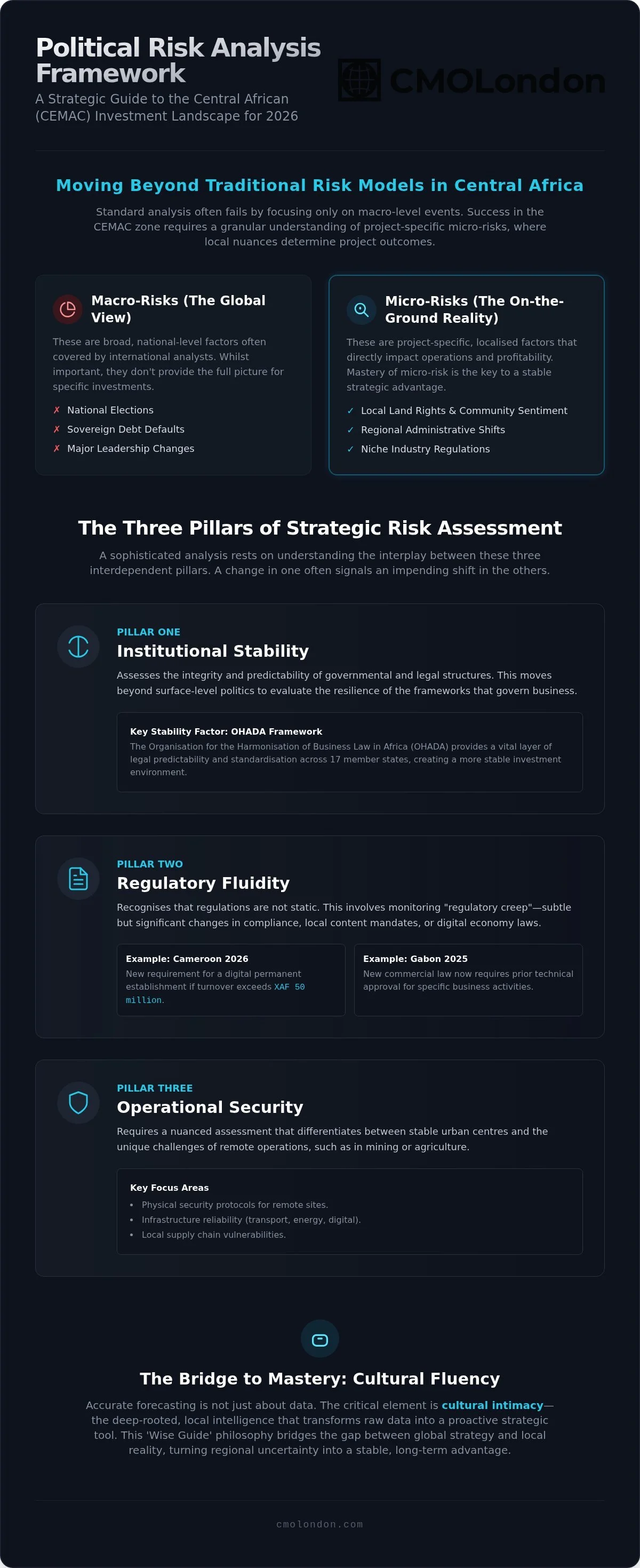
Political risk is traditionally understood as the probability that political decisions, events, or conditions will significantly impact the profitability of a business or the value of an investment. In our view, political risk is a dynamic interplay of regulation, security, and cultural behaviour. Whilst global analysts often focus on "macro-risk" factors like national elections or sovereign debt defaults, successful investors in the CEMAC region must also account for "micro-risk." This project-specific level involves local land rights, regional administrative shifts, or specific industry regulations that don't always make international headlines but can determine a project's success.
Conducting a thorough political risk analysis Central Africa requires moving beyond the broader continental trends often seen in West Africa. The Central African Economic and Monetary Community (CEMAC) presents a unique landscape where regional integration acts as both a buffer and a complexity. Unlike other regions, the deep institutional ties between member states create a specific ecosystem where national policy is often tethered to regional consensus.
The Role of the CEMAC Economic Zone
Regional integration serves as a critical risk-mitigation factor that many outsiders overlook. Through the Bank of Central African States (BEAC), the CEMAC zone maintains a pegged currency that provides a layer of monetary stability rarely found in volatile emerging markets. This regional oversight exerts a stabilising influence on national fiscal policies, as member states like Gabon and Cameroon must align with broader community standards. For the strategic investor, this means that whilst individual countries face specific challenges, the regional framework provides a predictable baseline for capital movement and trade.
Why Traditional Models Often Fail in Central Africa
Standard risk models frequently fall short because they rely too heavily on quantitative data from international NGOs that may lack recent, on-the-ground context. Numbers alone don't capture the nuances of local government relations or the subtle shifts in community sentiment. We've found that cultural intimacy is a prerequisite for accurate forecasting. Our "Wise Guide" philosophy combines rigorous data with the kind of deep-rooted, local intelligence that only comes from a long-standing presence. This approach ensures that your political risk analysis Central Africa isn't just a reactive report, but a proactive tool for strategic project direction.
The Three Pillars of Strategic Risk Assessment
Effective political risk analysis Central Africa rests upon three foundational pillars that allow UK investors to move beyond broad generalisations. We categorise these as institutional stability, regulatory fluidity, and operational security. Whilst some firms focus exclusively on leadership changes, a sophisticated approach recognises that these pillars are interdependent. A shift in constitutional integrity often precedes changes in local content requirements or shifts in physical security protocols in remote mining or agricultural sites. By examining how these elements coalesce, we provide the clarity required to navigate political and economic uncertainty in Central Africa with confidence.
Navigating OHADA and CEMAC Regulations
The OHADA framework provides a vital layer of legal predictability across 17 member states, yet investors must remain vigilant regarding "regulatory creep." For instance, Cameroon's new requirement, effective January 2026, for a digital permanent establishment if turnover exceeds XAF 50 million demonstrates how quickly the landscape evolves. Similarly, Gabon's 2025 commercial law now requires prior technical approval for specific activities. Maintaining compliance whilst optimising your business processes requires a partner who understands these nuances at a granular level. Our expertise in strategic consulting management helps firms adapt to these shifts before they impact the bottom line.
Assessing Security and Infrastructure Risks
A robust political risk analysis Central Africa must also differentiate between urban stability and remote operational challenges. There is a stark difference between the relative stability of urban centres like Libreville or Douala and the logistical complexities of remote operations in Chad or eastern Cameroon. Infrastructure deficits, such as energy shortages or transport bottlenecks, often act as a multiplier for political risk by delaying project delivery and inflating costs. Addressing these challenges involves more than just private security; it requires deep-rooted community engagement. By partnering with local entities and leveraging on-the-ground intelligence, firms can secure their assets and personnel whilst fostering the long-term trust necessary for sustainable growth.
Comparative Risk Profiles: Gabon, Cameroon, and Chad
A sophisticated political risk analysis Central Africa reveals that whilst the CEMAC region shares a common currency, the investment climates of its primary hubs are remarkably distinct. Choosing the right entry point requires a nuanced understanding of each nation's unique trajectory and regulatory appetite. Recent developments, highlighted in a UN Security Council briefing on Central Africa, underscore that political progress often walks alongside complex security and humanitarian dynamics. To help project directors prioritise their market entry, we have identified the following comparative profiles:
Gabon: Transitioning towards a post-oil economy with a focus on sustainable tourism and mining.
Cameroon: Acting as the regional economic engine whilst tightening digital and local content regulations.
Chad: Offering high growth potential in energy and infrastructure amidst a restructured fiscal landscape.
Gabon: A Strategic Hub for Sustainable Trade
Gabon is pivoting towards a post-oil future with a clear focus on resource diversification and sustainable tourism. The enactment of Law No. 005/2025 in March 2025 has introduced new requirements for prior technical approval in regulated sectors, signalling a move towards more structured market oversight. Investors should note the 2025 Finance Act, which offers CIT exemptions for tourism and hotel businesses for their first three years, provided they meet the minimum investment threshold of XAF 300 million. We facilitate this entry by aligning your market strategy with these new incentives, ensuring you navigate the raw manganese export ban scheduled for 2029 with foresight. CMOLondon provides the strategic project direction required to bridge the gap between these new regulations and operational reality.
Cameroon and Chad: Diversification and Resilience
Cameroon remains the economic engine of the CEMAC zone, with growth projected at 3.3% for 2026. However, the regulatory environment is becoming more sophisticated, particularly with the introduction of the digital permanent establishment rules on 1 January 2026. Navigating this bilingual landscape requires cultural intimacy and a deep understanding of the new investment incentives framework, which prioritises local skills development and the use of Cameroonian contractors.
Chad presents a different set of opportunities, with economic growth estimated at 5% in 2026 despite regional security pressures. The 2026 Finance Law has introduced significant changes, including a 50% reduction in SEZ tax exemptions and mandatory e-invoicing for public expenditure. Balancing this high-growth potential with informed risk mitigation involves assessing the physical safety of assets whilst capitalising on new tax credits for professional training. We guide our partners through these intricacies, providing the on-the-ground intelligence needed to maintain stability in these resilient markets.
A Step-by-Step Methodology for Conducting a Risk Audit
Success in the CEMAC region is rarely the result of chance; it's the outcome of a methodical, disciplined approach to identifying and neutralising threats before they manifest. A professional political risk analysis Central Africa should move beyond passive observation and into active strategic planning. We recommend a five-step methodology that integrates regional expertise with rigorous project oversight to ensure your operations remain resilient against shifting tides.
Step 1: Define Project Scope and Geographic Focus. Pinpoint the exact jurisdiction within the CEMAC zone, as risks in Libreville differ significantly from those in the Chadian interior.
Step 2: Identify Key Stakeholders. Map out government relations, regional regulators, and influential community leaders who shape the local operating environment.
Step 3: Conduct a Gap Analysis. Contrast international compliance standards with local OHADA realities and cultural behaviours to identify potential friction points.
Step 4: Develop a Tiered Mitigation Strategy. Implement preventative controls through due diligence, detective measures via real-time monitoring, and corrective protocols for crisis management.
Step 5: Establish a Continuous Monitoring Loop. Risk isn't static, so your audit shouldn't be either; integrate tracking into your daily project direction to stay ahead of regulatory shifts.
Building a Local Intelligence Network
In the complex markets of Central Africa, who you know is often as critical as what you know. Relying solely on international news feeds or high-level economic reports often leaves a dangerous intelligence gap. A robust network of local sources provides real-time updates on political sentiment and administrative changes that haven't yet reached the public domain. As strategic consultants, we act as both cultural and professional bridges, translating these subtle on-the-ground signals into actionable business intelligence. This proximity allows our partners to make decisions based on intimacy rather than guesswork.
Implementing Project Oversight and Direction
Professional oversight is the mechanism that transforms a risk audit from a static document into a living shield. Steady, methodical management reduces operational friction by ensuring that commercial outcomes remain aligned with the evolving political landscape. Whilst off-the-shelf risk reports offer a broad overview, they lack the specificity required for complex project delivery in 2026. If you require a partner to lead this process, our strategic consulting management services provide the oversight needed to secure your regional footprint and foster long-term stability.
CMOLondon: Your Sophisticated Bridge to Central African Mastery
Mastering the complexities of the CEMAC region requires more than a subscription to a remote data feed; it demands a partner with a long-standing, physical presence and deep cultural fluency. Our firm brings a 12-year legacy of navigating the specific intricacies of Gabon, Cameroon, and Chad. Led by Elizabeth Traore-Andony, we operate as a "Wise Guide" for international firms, providing the rare, on-the-ground insights that outsiders often lack. We believe that true strategic confidence is built on a foundation of trust and cultural intimacy, allowing us to act as a sophisticated bridge between global ambitions and local realities.
Our methodology moves beyond the passive observation found in traditional risk reports. We integrate political risk analysis Central Africa into a broader framework of executive support, ensuring that your leadership team possesses the tools to make informed decisions in real-time. By combining high-level strategic confidence with a grounded acknowledgement of regional challenges, we transform potential uncertainty into a state of clarity and mastery. This tireless dedication to our partners has established us as a veteran presence in the market, focused on building long-term value rather than short-term gains.
Bespoke Strategic Consulting and Project Direction
We recognise that every industry faces a unique set of pressures, which is why we tailor our political risk analysis Central Africa to your specific project goals. Whether you are navigating the new commercial laws in Gabon or the digital tax thresholds in Cameroon, our approach ensures your business processes remain resilient. Our expertise in Strategic Consulting Management allows us to identify regulatory shifts before they impact your operations, whilst our focus on Project Direction ensures that your commercial objectives are met with methodical precision. We help you move from a state of reactive troubleshooting to proactive market leadership.
Next Steps: Securing Your Central African Venture
Engaging with the CEMAC market is an exciting prospect, yet it requires a steady hand and a clear roadmap. We invite you to begin your journey with a comprehensive market entry audit or a bespoke risk assessment tailored to your 2026 objectives. Beyond institutional strategy, we also offer Personal Coaching for executives, helping leaders manage the unique stresses and cultural nuances of remote African operations with poise and effectiveness. This holistic approach ensures that both the project and its leadership are positioned for enduring success.
Our commitment to the region extends beyond the boardroom. We are deeply invested in the sustainable growth of the communities we serve, with a particular focus on supporting early childhood development initiatives. This values-driven approach ensures that your investment contributes to a prosperous future for the region whilst securing your commercial legacy. To begin a partnership built on integrity and elite expertise, please enquire about our Strategic Consulting Management services today.
Transforming Regional Complexity into Commercial Clarity
The 2026 landscape in the CEMAC region presents a unique paradox of high-growth potential and intricate regulatory shifts. Successfully navigating this environment requires moving beyond generic assessments and embracing a tailored political risk analysis Central Africa. By prioritising the three pillars of institutional stability, regulatory fluidity, and operational security, you can transform perceived uncertainty into a structured roadmap for growth. We've seen that those who lead with cultural intimacy and informed project direction are the ones who secure the most resilient market positions.
Mastery of these markets isn't achieved through distance; it's earned through on-the-ground intimacy and methodical oversight. With 12 years of experience in Gabon, Cameroon, and Chad, we provide the UK-based strategic oversight and specialised regional compliance knowledge necessary to bridge the gap between global standards and local realities. We invite you to partner with CMOLondon for expert CEMAC market entry and project direction. Together, we can turn regional complexity into a stable, long-term strategic advantage that fosters both commercial success and sustainable regional development. We look forward to guiding your venture toward its full potential.
Frequently Asked Questions
What is the current political risk rating for the CEMAC region in 2026?
The 2026 risk landscape is nuanced rather than monolithic. S&P confirmed Chad's sovereign rating at "B-" with a stable outlook in March 2026, whilst the IMF projects economic growth of 3.3% for Cameroon and 5% for Chad. Gabon's revised 2026 budget projects a fiscal deficit of roughly 6.7%. These figures suggest that whilst challenges remain, specific sectors offer significant stability for investors who employ a methodical political risk analysis Central Africa.
How do OHADA regulations affect political risk analysis in Central Africa?
OHADA provides a standardised legal framework across 17 member states, which significantly reduces legal uncertainty. However, political risk analysis Central Africa must still account for national-level implementations, such as Gabon's Law No. 005/2025 regarding technical approvals or Cameroon's 2026 digital permanent establishment rules. These regulations harmonise business law whilst allowing for specific national mandates that require expert navigation to ensure full compliance and operational continuity.
Can UK firms successfully manage remote operations in Gabon and Cameroon?
UK firms can manage remote operations successfully by prioritising strategic project direction and local intelligence. The key lies in recognising the distinction between urban stability in centres like Douala and the logistical complexities of the interior. By partnering with a "Wise Guide" who possesses cultural intimacy, firms can establish reliable communication loops and security protocols that safeguard assets in even the most challenging geographic environments.
What are the primary trade barriers when entering the Central African market?
Primary barriers include evolving local content requirements and infrastructure deficits. For example, Cameroon's 2025 framework requires investors to demonstrate local skills development and prioritise Cameroonian nationals in recruitment. Additionally, Gabon's upcoming 2029 ban on raw manganese exports highlights the shift towards local value addition. Navigating these barriers requires a proactive approach to business process management and a deep understanding of regional industrialisation trends.
How does CMOLondon differ from traditional global risk agencies?
Unlike traditional agencies that rely on quantitative data and generic subscriptions, we provide bespoke strategic consulting management rooted in 12 years of on-the-ground CEMAC experience. Our "Wise Guide" philosophy combines high-level oversight with personal coaching for executives, ensuring that leadership teams are culturally fluent and strategically prepared. We move beyond passive reporting to offer active project direction that transforms regional uncertainty into a stable commercial advantage.
Is it possible to mitigate the risk of sudden policy changes in the region?
Mitigating sudden policy changes is possible through a continuous monitoring loop and a tiered mitigation strategy. By establishing preventative controls and maintaining deep-rooted government relations, firms can often anticipate shifts before they're formalised. Our approach involves a constant "Gap Analysis" between international standards and local realities, allowing us to adjust business processes methodically whilst others are still reacting to new legislative announcements.
What role does government relations play in project direction?
Government relations are the cornerstone of successful project direction in the CEMAC zone. They're essential for securing technical approvals, such as those required by Gabon's 2025 commercial law, and for aligning projects with national economic diversification goals. Strong relations foster trust and provide a channel for resolving administrative friction points, ensuring that project delivery timelines remain on track despite the inherent complexities of the regional bureaucracy.
How do I start a market entry strategy for the Republic of Congo or Chad?
A successful entry strategy begins with a rigorous risk audit and a clearly defined geographic focus. For Chad, this involves navigating the 2026 Finance Law's mandatory e-invoicing and reduced SEZ tax exemptions. For the Republic of Congo, it requires assessing the specific regulatory climate under OHADA. We recommend engaging a strategic consultant early to bridge the gap between global trade standards and the unique cultural nuances of these high-