
Cross-Border Project Management in the CEMAC Region: A Strategic Delivery Guide (2026)

What if the greatest barrier to your expansion in Central Africa isn't the physical distance, but the invisible friction of misaligned regulatory frameworks? You've likely realised that whilst the CEMAC region offers immense growth potential, the reality of synchronising operations across Cameroon, Gabon, or Chad often feels like navigating a labyrinth of OHADA regulations and fragmented logistics. It's a common frustration for UK-based directors who find that traditional frameworks struggle to bridge the gap between London's boardrooms and the intricate realities of Central African sites.
This guide provides a definitive roadmap to master cross-border project management CEMAC in 2026, ensuring your strategic delivery remains robust despite regional complexities. We'll show you how to align international standards with local nuances, reducing operational risk whilst maintaining high-level control. We'll explore the latest 2026 banking law updates, the strict enforcement of e-procurement systems like COLEPS, and the strategic shifts required to turn regional fragmentation into a cohesive competitive advantage. By the end of this briefing, you'll possess the clarity needed to lead multi-country programmes with the confidence of a seasoned veteran who truly understands the ground they stand on.
Key Takeaways
Understand the 2026 CEMAC landscape by distinguishing between high-level policy and the practical operational realities of moving resources across the six member nations.
Master the OHADA Uniform Acts to ensure your legal foundation remains secure whilst effectively integrating local content requirements into your regional workforce strategy.
Optimise cross-border project management CEMAC by establishing a centralised direction model with localised execution nodes to streamline logistics through the Douala and Libreville corridors.
Build organisational resilience by conducting sophisticated risk assessments that account for both physical security and the shifting regulatory environments within Central Africa.
Bridge the gap between your UK headquarters and regional sites by leveraging expert Project Direction that aligns international standards with deep-rooted cultural intimacy.
Table of Contents
Navigating the Regulatory Framework: OHADA and Local Compliance
How to Organise Cross-Border Logistics and Resource Management
Partnering for Success: Professional Project Direction with CMOLondon
Understanding the CEMAC Landscape for Project Delivery
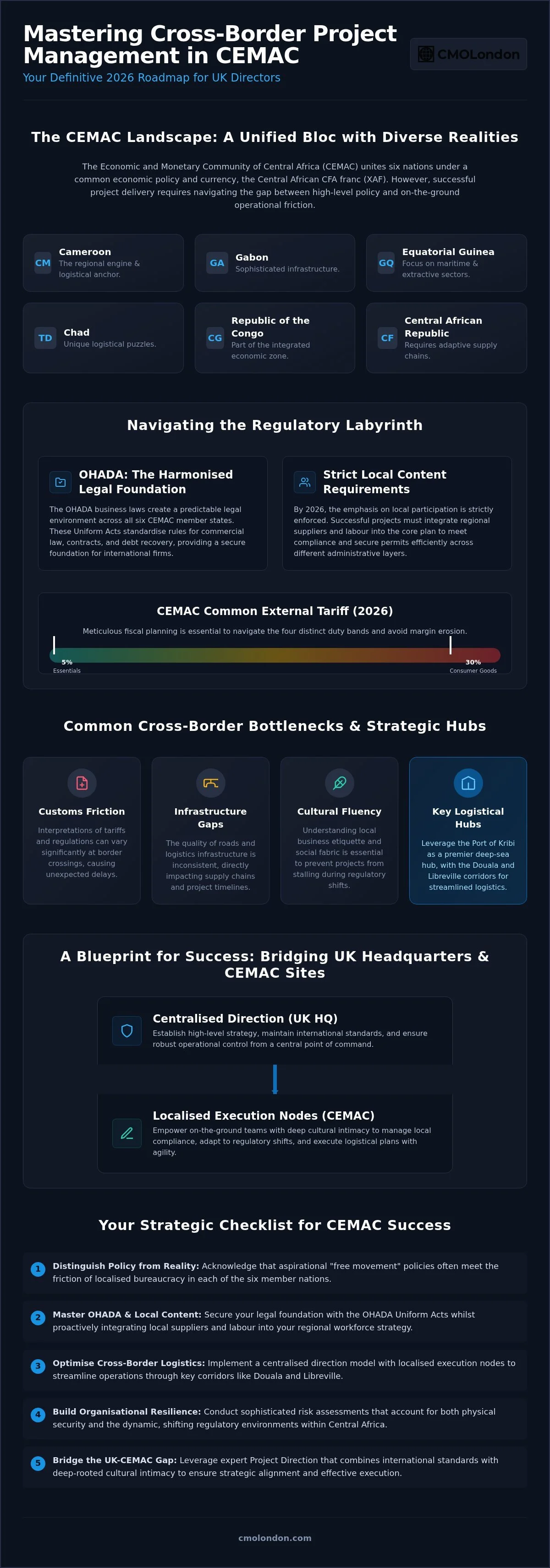
The Economic and Monetary Community of Central Africa (CEMAC) represents a unified economic bloc of six nations: Cameroon, Gabon, Chad, the Central African Republic (CAR), the Republic of the Congo, and Equatorial Guinea. Bound by a shared currency, the Central African CFA franc (XAF), these nations aim for deep economic integration and harmonised trade. Whilst the policy framework suggests a seamless flow of goods and labour, the practical execution of cross-border project management CEMAC requires a more nuanced approach. In 2026, we see a landscape where ambitious regional goals often meet the friction of localised bureaucracy.
Successful delivery depends on acknowledging that "free movement" is often an aspirational policy rather than a daily operational reality. Projects frequently stall because a central strategy, perhaps designed in a distant headquarters, fails to account for the specific administrative heartbeat of an individual member state. This creates a gap where momentum is lost amongst conflicting priorities. You need a sophisticated bridge-builder who possesses the cultural intimacy to translate high-level objectives into ground-level results across these diverse jurisdictions.
The Six-Nation Bloc: From Cameroon to Gabon
Each member state offers a distinct project environment that demands bespoke attention. Cameroon serves as the regional engine, whilst Gabon and Equatorial Guinea provide sophisticated infrastructure geared towards the extractive and maritime sectors. Chad and the CAR present unique logistical puzzles that require resilient, adaptive supply chain thinking. A critical pivot point for the region is the Port of Kribi in Cameroon; it has matured into a premier deep-sea hub that anchors regional logistics for the entire bloc. The CEMAC common market serves as a strategic gateway for UK investors seeking to anchor long-term capital in Central Africa during 2026.
Identifying Common Cross-Border Bottlenecks
Moving heavy equipment or specialised personnel between jurisdictions isn't merely a matter of distance. Friction points usually emerge at border crossings where customs interpretations can vary despite the existence of a Common External Tariff. Infrastructure quality remains inconsistent across the zone; a well-paved corridor in one district might give way to seasonal challenges in another, directly impacting project timelines. Technical mastery of cross-border project management CEMAC is insufficient without deep cultural fluency. Understanding the social fabric and local business etiquette is what truly prevents a project from grinding to a halt when unforeseen regulatory shifts occur. It's about knowing who to speak with as much as knowing which form to file.
Navigating the Regulatory Framework: OHADA and Local Compliance
Achieving successful cross-border project management CEMAC requires more than technical skill; it demands a deep mastery of the regional legal architecture. At the heart of this is the OHADA business laws, which provide a harmonised framework across 17 African states, including all six CEMAC members. These Uniform Acts govern everything from commercial law to debt recovery, creating a predictable environment for international firms. However, predictability doesn't mean simplicity. Navigating the 2026 CEMAC Common External Tariff, which now structures duties into four distinct bands ranging from 5% for essentials to 30% for consumer goods, requires meticulous fiscal planning to avoid margin erosion.
Effective government relations are the silent engine of project delivery. Securing permits in Chad or Cameroon often involves engaging with multiple layers of administration where local content requirements are strictly enforced. By 2026, the emphasis on local participation has intensified, making it vital to integrate regional suppliers and labour into your core project plan. For directors seeking to de-risk these interactions, engaging a partner for expert Project Direction can ensure that regulatory hurdles are cleared before they impact the schedule.
Aligning UK Standards with OHADA Regulations
Mapping British project governance onto the OHADA system requires a translation of both language and legal logic. Contract enforcement and dispute resolution must be designed with multi-jurisdictional realities in mind, particularly with the English version of the new Uniform Act on Simplified Recovery Procedures now available. In 2026, UK firms must ensure total compliance with the revised COBAC banking framework and Cameroon's zero-tolerance e-procurement regime (COLEPS) to maintain their operational standing.
Labour Laws and Cross-Border Workforce Management
Executing cross-border project management CEMAC requires a mobile workforce that can navigate a complex dance of work permits and local employment contracts. Whilst the CEMAC passport exists, international staff still face varying residency requirements in Gabon or Equatorial Guinea. Best practice involves mirroring UK ethical standards whilst adhering to local labour codes, ensuring that CSR initiatives are deeply rooted in the communities where you operate. This dual focus builds the long-term trust necessary for sustained project success.
How to Organise Cross-Border Logistics and Resource Management
Organising a multi-country operation in Central Africa requires a "hub and spoke" architecture that balances centralised oversight with localized agility. Successful cross-border project management CEMAC relies on establishing a primary project office, often in a commercial centre like Douala or Libreville, which serves as the strategic heart of the operation. This central unit maintains the "single version of truth" whilst delegating execution to localized nodes in N'Djamena or Brazzaville. This structure ensures that whilst the project director maintains high-level control, the team on the ground possesses the autonomy to navigate local administrative nuances without waiting for London-time approvals.
Supply chain optimisation is equally vital. With the Africa cross-border road freight market valued at USD 10.2 billion in 2026, the stakes for efficient movement are high. Moving materials through the Douala or Libreville corridors demands a proactive approach to transit tracking. Digital transformation has become a non-negotiable asset; using real-time data allows project directors to monitor remote Central African operations with precision. This visibility is essential when managing the repatriation of funds or navigating the Bank of Central African States (BEAC) regulations, which were updated in April 2026 to raise the forex repatriation threshold for the extractive sector.
Streamlining Customs and Border Transitions
Delays at border crossings can quickly erode project margins. To mitigate this risk, you should adopt a methodical approach to equipment transfer. Preparing for a cross-border transition involves several critical steps:
Detailed Inventory Mapping: Ensure every piece of equipment is listed with its corresponding Harmonised System (HS) code to match the 2026 CEMAC Common External Tariff.
Temporary Importation Permits: Secure "Admission Temporaire" for machinery intended to return to its origin to avoid unnecessary duties.
Accredited Clearing Agents: Partner with local agents who possess a proven track record with regional customs authorities.
Advance Documentation: Submit manifests to border posts at least 48 hours prior to arrival to expedite the physical inspection process.
Optimising Payments and Financial Settlement
Managing intra-regional project costs requires a sophisticated understanding of the Pan-African Payment and Settlement System (PAPSS). By 2026, PAPSS integration has matured, allowing for faster, more transparent settlements across CEMAC borders in local currency. This reduces the friction of XAF currency volatility and simplifies the complex task of fund repatriation to the UK. Refining your internal financial workflows is a cornerstone of Business Process Management, ensuring that your capital remains as mobile as your workforce. It's about building a financial bridge that supports long-term commercial stability whilst respecting the revised 2026 COBAC banking laws.
Mitigating Operational Risks in Central African Projects
Risk in Central Africa is often mischaracterised as purely a security concern. Whilst physical safety in specific regions remains paramount, sophisticated cross-border project management CEMAC requires a broader lens that encompasses regulatory and economic volatility. For instance, the July 2026 initiative by COBAC to revise banking laws signifies a shift that could alter project financing and capital movement overnight. A robust risk assessment must account for these macro-level changes alongside micro-level logistical hurdles. It's about moving from a reactive stance to a "Wise Guide" approach, where local intelligence pre-empts hurdles before they manifest as costly delays on a Gantt chart.
Maintaining stakeholder trust serves as the bedrock of project continuity. This involves more than transparent reporting to a UK headquarters; it requires deep cultural sensitivity to the expectations of local ministries and community leaders. When project directors demonstrate an understanding of the regional social fabric, they build a reservoir of goodwill. This trust proves invaluable when navigating the inevitable unpredictability of regional logistics, allowing for smoother negotiations when timelines require adjustment.
Managing Remote Teams Across Multiple Jurisdictions
Synchronising a UK headquarters with teams in Libreville or N'Djamena requires rigorous communication protocols that bridge the geographical and cultural divide. Linguistic fluency is non-negotiable; whilst English is the global business standard, French remains the administrative heartbeat of the region, and Spanish is essential for operations in Equatorial Guinea. In areas where digital infrastructure is limited, we utilise low-bandwidth project monitoring tools to ensure data flows remain constant. This prevents the "information vacuum" that often leads to strategic misalignment between the board and the site.
Building Resilience Against Regional Volatility
Resilience isn't an accident; it's a deliberate design choice. We develop contingency plans that account for sudden regulatory shifts, such as the Cameroon Digital Services Tax introduced in early 2026 for companies with a significant economic presence. Strategic partnerships with local entities ensure that even if one supply route is restricted, project execution continues via alternative corridors. On-the-ground proximity remains the single most effective tool for identifying and mitigating risk before it impacts your commercial outcomes. To secure your delivery and manage these intricacies, partner with CMOLondon for expert Project Direction services.
Partnering for Success: Professional Project Direction with CMOLondon
Success in Central Africa isn't measured merely by the launch of a project, but by its sustained operational excellence and commercial resilience. CMOLondon serves as the vital link between your UK headquarters and the unique complexities of the CEMAC zone. By leveraging over 12 years of specialised regional experience, we provide the steady hand required to oversee cross-border project management CEMAC with precision. We don't just advise; we act as your dedicated Project Director, ensuring that every strategic objective is met whilst navigating the intricate regulatory pulses of Cameroon, Gabon, and the wider region.
Our role involves a deep commitment to Business Process Management, where we refine your operational workflows to match the regional reality. This alignment reduces the friction of distance that often plagues international initiatives. We ensure that your project remains compliant with the evolving 2026 COBAC banking laws and OHADA Uniform Acts, transforming potential regulatory hurdles into structured steps toward success. It's about providing a sense of stability in a market that rewards those with the foresight to plan for its nuances.
The CMOLondon Approach to Project Direction
We guide our clients through the entire journey, from the initial market entry strategy to long-term operational oversight. Our expertise in Strategic Consulting Management allows us to facilitate high-level government relations and stakeholder engagement that outsiders often find inaccessible. We understand the administrative heartbeat of the region. This cultural intimacy ensures that permits are secured and local content requirements are integrated seamlessly into your project plan, maintaining momentum through even the most complex multi-jurisdictional shifts.
Ensuring Long-Term Commercial Viability
The lifecycle of a Central African initiative requires constant vigilance and adaptation. We focus on ensuring that your commercial outcomes are aligned with sustainable regional development, creating a footprint that benefits both your shareholders and the local communities. By synchronising international project rigour with localised execution, we protect your investment against the volatility discussed in previous sections. If you're ready to bridge the gap between global ambition and Central African delivery, we invite you to Enquire about our Project Direction services today. Our team is dedicated to leading you through these paths with the integrity and mastery your programme deserves.
Mastering the Central African Horizon
The complexity of the Central African market in 2026 demands a shift from traditional oversight to a model of deep-rooted partnership. You've seen that success hinges on more than just logistical efficiency; it requires the synchronisation of international project standards with the unique regulatory heartbeat of the OHADA zone. By prioritising cultural intimacy and building resilience into every timeline, you transform the fragmented reality of regional borders into a cohesive strategic advantage.
True mastery of cross-border project management CEMAC isn't achieved in isolation. It's the result of informed decision-making and a commitment to understanding the ground-level administrative nuances that outsiders often overlook. With over 12 years of specialised regional experience, CMOLondon provides the deep cultural and regulatory intimacy required to bridge these worlds, offering bespoke project direction that ensures your commercial outcomes remain secure.
Now is the moment to turn your regional ambitions into a legacy of sustainable growth. Secure your Central African project delivery with CMOLondon and lead your initiative with the confidence of a seasoned veteran. The potential of the CEMAC market is vast, and with the right guide, your path to delivery is clear.
Frequently Asked Questions
What are the primary challenges of cross-border project management in the CEMAC region?
Primary challenges include navigating the "free movement" policy versus ground-level administrative reality. Whilst the bloc shares a currency, infrastructure quality varies significantly across the six nations. Successful cross-border project management CEMAC requires addressing these frictions through proactive planning and localised execution. Directors must account for the 2026 e-procurement mandates in Cameroon and the security risks in parts of the Lake Chad Basin to maintain their delivery schedules.
How does OHADA law affect project delivery for UK companies?
OHADA law provides a harmonised legal framework that simplifies contract enforcement and debt recovery across the region. For UK companies, this means mapping British governance onto the OHADA Uniform Acts to ensure total compliance. The 2026 availability of the English version of the Act on Simplified Recovery Procedures has made this transition smoother. It allows international firms to navigate disputes with greater predictability whilst maintaining high standards of corporate integrity.
Can I move project equipment freely between CEMAC member states?
You cannot move equipment entirely without restriction; you must adhere to the 2026 CEMAC Common External Tariff (CET). This tariff structures duties into four bands, ranging from 5% for essential goods to 30% for consumer products. To avoid unnecessary costs, projects should use "Admission Temporaire" for machinery. Partnering with accredited local clearing agents is vital to expedite physical inspections at strategic border crossings like the Douala to Bangui corridor.
What is the role of the BEAC in project financial management?
The Bank of Central African States (BEAC) regulates the Central African CFA franc (XAF) and oversees all foreign exchange repatriation. In April 2026, the BEAC raised the forex repatriation threshold specifically for the extractive sector, impacting how project funds are managed. Navigating these currency controls is a core component of cross-border project management CEMAC. It ensures that capital remains mobile whilst complying with the revised COBAC banking laws initiated in July 2026.
How do I manage the linguistic diversity of teams in the CEMAC zone?
Managing linguistic diversity requires a strategy that goes beyond simple translation to include cultural intimacy. Whilst English is the standard for UK headquarters, French is the administrative heartbeat of the region, and Spanish is essential for Equatorial Guinea. We recommend using bilingual project leads and low-bandwidth digital tools to ensure constant communication in remote areas. This prevents an information vacuum and ensures that strategic objectives are clearly understood at every site.
What are the benefits of hiring a project direction consultant for Central Africa?
Hiring a project direction consultant provides the "Wise Guide" insights necessary to pre-empt operational hurdles before they occur. A consultant with 12 years of regional experience acts as a bridge between international standards and Central African realities. They offer bespoke Business Process Management to align your corporate goals with local regulatory nuances. This reduces operational risk and ensures that your Central African initiative reaches commercial maturity with minimal friction.
Is the PAPSS system available for all commercial project payments in 2026?
The Pan-African Payment and Settlement System (PAPSS) is widely available in 2026 for intra-regional commercial payments within CEMAC. This system allows for faster settlements in local currency, significantly reducing the risks associated with XAF volatility. Whilst integration is high across member states, it's prudent to verify the specific banking status in the CAR or Chad. Using PAPSS streamlines your financial workflows and ensures that project costs are settled with greater transparency.
How does CMOLondon support UK firms with government relations in Gabon or Cameroon?
CMOLondon facilitates high-level stakeholder engagement by leveraging a decade of presence and deep cultural fluency in the region. We help UK firms navigate the strict local content requirements in Gabon and the zero-tolerance e-procurement regime in Cameroon. By acting as a strategic Project Director, we ensure that your government relations are handled with the sophistication required to secure permits. This proactive approach builds the long-term trust needed for sustained commercial success.