
The Essential Project Delivery Framework for Central Africa: A Strategic Checklist

The most sophisticated project management software in the world cannot account for a sudden shift in CEMAC foreign exchange regulations or the nuanced cultural protocols of a boardroom in Central Africa. For international investors and UK firms, implementing a successful project delivery framework Central Africa requires more than just technical skill; it demands a deep-rooted cultural intimacy. You likely recognise that the region offers unparalleled growth potential, yet the uncertainty surrounding OHADA compliance and the fear of project stagnation remain persistent concerns. It's a valid perspective; navigating the 2026 landscape requires a sophisticated bridge between global standards and local operational realities.
Mastering this environment involves a strategic roadmap to mitigate regional risks, from the BEAC's recent integration with the Pan-African Payment and Settlement System to the evolving digital tax laws in Cameroon. This article provides a comprehensive checklist designed to ensure your investments move from initial concept to successful execution with precision. We'll explore how to maintain momentum whilst respecting the intricate regulatory fluidity of the CEMAC zone. By the end of this guide, you'll possess the clarity needed to lead your projects with the confidence of a seasoned veteran, ensuring your strategic objectives are met with integrity and long-term stability.
Key Takeaways
Understand why standard project methodologies often falter in the CEMAC region and how to align corporate strategy with Central African trade policies.
Master the essential components of a robust project delivery framework Central Africa by integrating OHADA uniform acts into your contract management.
Develop regulatory readiness by navigating the intricacies of the CEMAC customs union to mitigate risks and prevent project stagnation.
Establish long-term operational continuity through sophisticated stakeholder engagement and the nuanced art of regional government relations.
Discover how to transition from theoretical planning to successful execution by adopting a project direction model informed by deep-rooted cultural intimacy.
Table of Contents
Navigating Project Complexity in the CEMAC Region
A project delivery framework Central Africa serves as the essential architecture for any major initiative, providing a structured methodology that governs a project from its initial inception through to its final commercial outcome. For international investors and national-level UK firms, this framework is more than a set of rules; it's a strategic compass. It ensures that high-level corporate objectives remain aligned with local execution, preventing the common disconnect that occurs when global standards meet regional operational realities. Without such a structure, even the most well-funded projects risk losing momentum amongst the intricate layers of local governance and trade protocols.
Success within the Economic and Monetary Community of Central Africa (CEMAC) requires a bespoke approach that differs significantly from domestic UK project management. The region presents a unique economic environment where technical proficiency must be balanced with deep cultural intimacy. We act as a "Wise Guide" in this space, leveraging over 12 years of regional experience to translate international expectations into tangible results. This involves moving beyond generic project management toward a model of Project Direction, where strategic oversight is informed by a grounded, realistic acknowledgement of regional complexities.
The Limitations of Generic Frameworks
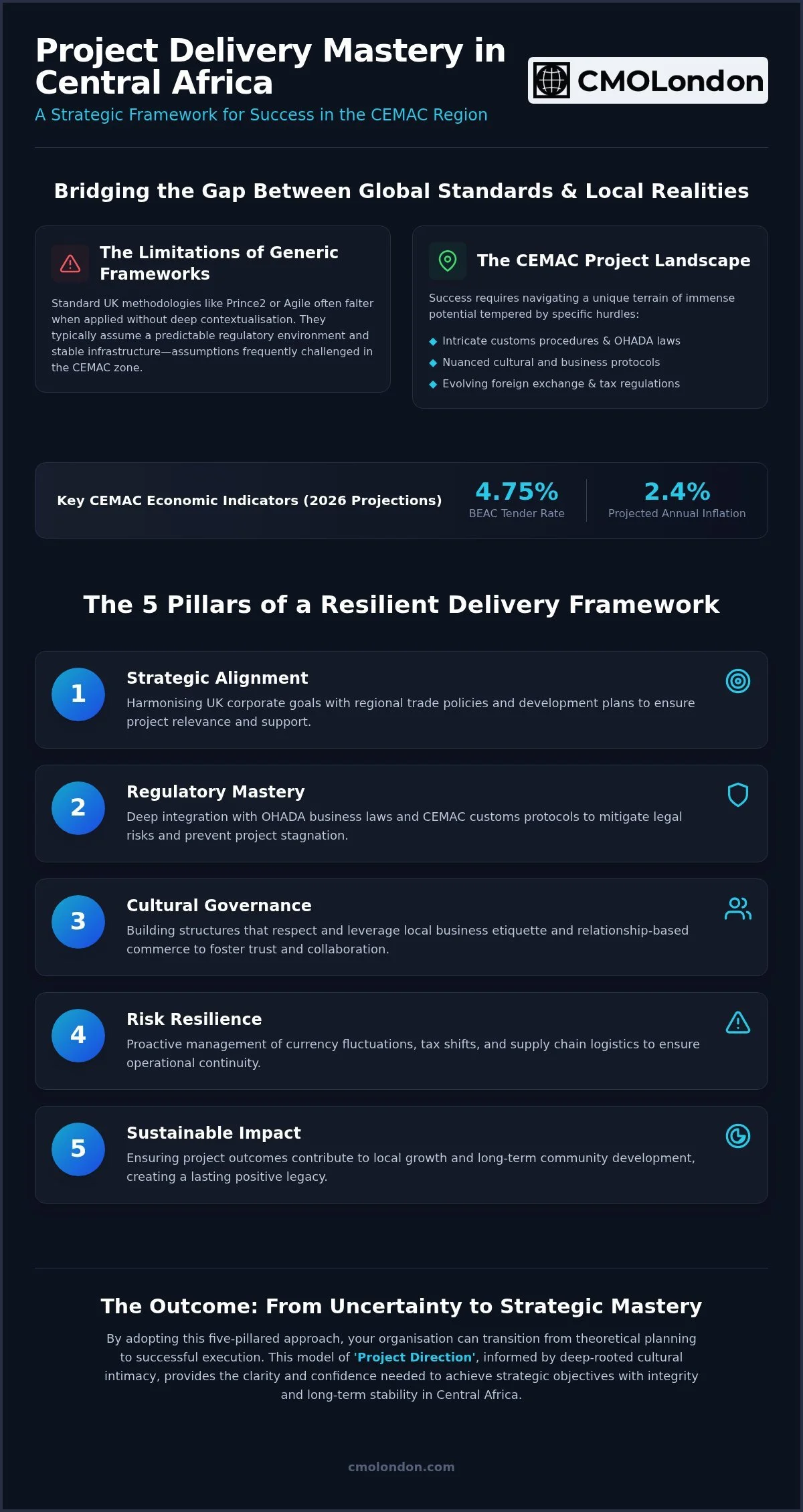
Whilst methodologies like Prince2 or Agile offer valuable tools for domestic projects, they often falter in Central Africa if applied without significant contextualisation. These frameworks typically rely on a predictable regulatory environment and stable infrastructure, assumptions that are frequently challenged in the CEMAC zone. For instance, a rigid Agile sprint might be derailed by a sudden shift in local administrative priorities or a delay in customs clearance. Culturally, the emphasis on relationship-building and face-to-face engagement means that project timelines must be flexible enough to accommodate the time required to build trust. A robust project delivery framework Central Africa acknowledges these nuances, ensuring that milestones are realistic and that the gap between London-based strategy and local reality is effectively bridged.
Defining the CEMAC Project Landscape
The economic landscape of Central Africa is one of immense potential tempered by specific logistical and bureaucratic hurdles. Investors must navigate a terrain where common bottlenecks, such as intricate customs procedures and infrastructure deficits, are the norm rather than the exception. With the BEAC tender rate held at 4.75% as of April 2026, and inflation projected at 2.4% for the year, the financial environment requires steady, informed decision-making. The CEMAC region is a unified but complex trade block requiring strategic mastery. Achieving this mastery involves understanding the interplay between the six member states and the overarching influence of OHADA business laws, which provide the legal certainty necessary for long-term stability.
The 5 Pillars of a Central Africa Project Delivery Framework
To construct a resilient project delivery framework Central Africa, one must move beyond the standard UK models that often focus on internal organisational competencies. A successful expansion into this region requires a five-pillared approach designed to withstand the unique pressures of the CEMAC zone. These pillars ensure that your initiative isn't just a technical success but a strategically integrated part of the regional economy. By focusing on these foundations, UK firms can transition from a state of uncertainty to one of high-level strategic mastery.
Strategic Alignment: Harmonising UK corporate goals with regional trade policies and development plans.
Regulatory Mastery: Deep integration with OHADA business laws and CEMAC customs protocols.
Cultural Governance: Building structures that respect and leverage local business etiquette and relationship-based commerce.
Risk Resilience: Proactive management of currency fluctuations, tax shifts, and supply chain logistics.
Sustainable Impact: Ensuring project outcomes contribute to local growth and long-term community development.
Pillar 1 & 2: Strategy and Regulation
Aligning project KPIs with regional development plans is essential for gaining local institutional support. This involves ensuring your project supports broader economic goals, such as the financial integration signalled by the BEAC joining the Pan-African Payment and Settlement System in July 2026. Before any ground is broken, a comprehensive regulatory audit must take place. This audit should integrate the latest OHADA legal standards, particularly following the April 2026 review of financial regulations and accounting procedures. By embedding these standards into your project delivery framework Central Africa, you create a robust layer of legal certainty that protects against administrative shifts.
Pillar 3 & 4: Culture and Risk
The third pillar, cultural governance, involves crafting a "context-first" communication plan for all regional stakeholders. In Central Africa, business is conducted through the lens of long-standing relationships; your framework must respect local etiquette whilst maintaining UK standards of transparency. Simultaneously, risk resilience requires a register that tracks variables like the standard 33% corporate tax rate in Cameroon or the specific environmental freezes on HFC production in the Central African Republic effective from January 2026. CMOLondon’s Project Direction service manages these pillars simultaneously, ensuring that cultural nuances and regulatory hurdles are navigated with the foresight of a seasoned partner. This dual focus allows for proactive adjustments rather than reactive crisis management, keeping your project on its intended path to commercial success.
Regulatory Readiness: A Compliance Checklist for Investors
Regulatory compliance is the cornerstone of any resilient project delivery framework Central Africa. Whilst the region offers significant rewards, the complexity of its legal landscape can often overwhelm those accustomed to UK domestic standards. Achieving regulatory readiness is not merely about ticking boxes; it's about deep integration with the regional legal architecture. This begins with a thorough understanding of the OHADA uniform acts, which provide a harmonised framework for commercial law across all CEMAC member states. These acts are directly applicable and supersede national laws, offering a level of legal certainty that is vital for long-term contract management.
Beyond the legal framework, project managers must navigate the CEMAC customs union. Understanding specific tariffs and the nuances of the regional trade block is essential for preventing costly delays at the border. Compliance also extends to local employment laws and expatriate quota regulations, which prioritise local workforce development whilst allowing for essential international expertise. Environmental standards are similarly evolving; for instance, the Kigali Amendment enters into force for the Central African Republic on 13 January 2026, requiring a freeze on HFC production. Such shifts underscore the need for a framework that is both proactive and locally informed.
Legal and Contractual Foundations
Ensuring that your contracts are enforceable under both UK and local jurisdictions is a critical step in mitigating risk. Whilst local legal representation is indispensable for specific filings, an international strategic advisor provides the necessary bridge to align these contracts with global corporate standards. This dual approach ensures that intellectual property and commercial secrets are protected within a framework that respects the regional legal reality. It's about creating a foundation where every stakeholder understands their obligations and the mechanisms for dispute resolution are clear and reliable.
Financial and Tax Compliance
Financial operations within the CEMAC zone are governed by strict BEAC regulations, particularly regarding the declaration of foreign direct investment and related proceeds. Under Regulation No 02/18/CEMAC/UMAC/CM, all FDI must be declared to the BEAC and national Finance Ministries to ensure transparency. The recent integration of the BEAC into the Pan-African Payment and Settlement System (PAPSS) in July 2026 is set to streamline these cross-border payments by the end of the year. Tax structures also require careful attention; the Republic of the Congo, for example, reduced its standard corporate tax rate from 30% to 28% in its 2026 Finance Law. Managing these variables, along with currency risk and profit repatriation, is fundamental to the long-term viability of your project.
Stakeholder Engagement and Operational Continuity
Operational continuity in the CEMAC region depends on a complex web of relationships that extend far beyond the boardroom. Whilst a robust project delivery framework Central Africa provides the technical roadmap, it's the strength of your local stakeholder engagement that ensures the project remains on track. Success here isn't merely about meeting deadlines; it's about securing the social and political licence to operate. This requires a shift from transactional interactions to a model of deep-rooted partnership, where international corporate standards are harmonised with local community expectations and government priorities.
The art of government relations in Central Africa is built on long-term trust and mutual understanding. UK firms must recognise that regional bodies and national ministries operate within a framework of consensus and relationship-building. Engaging with these entities requires a patient, methodical approach that respects local protocols whilst maintaining clear strategic objectives. By fostering these connections early, investors can mitigate the risk of project stagnation caused by bureaucratic hurdles or misunderstandings. It's this proactive engagement that transforms potential obstacles into collaborative milestones.
The Hierarchy of Regional Influence
Mapping the influence of key decision-makers is a critical component of your regional strategy. This involves identifying the specific roles within national ministries and understanding the overarching influence of regional bodies, such as those participating in the OHADA conference scheduled for September 2026 in Bangui. Effective cross-cultural negotiation isn't about compromise; it's about finding alignment between global standards and local realities. It requires a sophisticated understanding of regional etiquette, where subtle cues and indirect communication often carry as much weight as formal agreements. Mastering these dynamics allows for smoother dispute resolution and prevents the friction that often stalls international initiatives.
Ensuring Long-Term Project Stability
Stability is achieved when a project is seen as an integral part of the local ecosystem. Building a local talent pipeline isn't just a compliance requirement; it's a strategic investment in the project's longevity. When local communities see tangible benefits through community development or sustainable initiatives, the project gains a layer of resilience that no contract can provide. CMOLondon facilitates these critical connections by bridging the gap between international vision and local execution, ensuring your presence is both welcomed and enduring. To secure your project's future in the region, consider our specialised Strategic Consulting Management services to build a partnership strategy that lasts.
Strategic Project Direction: Bridging the Gap to Success
Theoretical plans often falter when they encounter the friction of on-the-ground execution. Transitioning from a London boardroom to active operations in the CEMAC zone requires a fundamental shift in perspective. Whilst many firms focus on "managing" a project, which often involves tracking tasks and timelines, true success in this region requires a project delivery framework Central Africa that embraces "Project Direction." This distinction is vital for long-term stability. Direction involves the strategic oversight and high-level decision-making necessary to steer an initiative through shifting regulatory sands and cultural complexities. It's about being the architect of the outcome, not just the keeper of the schedule.
We leverage over 12 years of regional experience to ensure this transition is seamless. By moving beyond tactical management, we provide the strategic leadership required to align every operational move with your overarching corporate goals. This approach transforms a project from a series of tasks into a resilient commercial asset. It's a methodology born from a grounded, realistic acknowledgement of regional intricacies, ensuring that your investment is protected by a sophisticated bridge between global standards and local realities.
Bespoke Advisory for Complex Markets
Every sector, from energy and infrastructure to international trade, carries its own set of intricate requirements. A project delivery framework Central Africa that works for a logistics venture in Gabon won't necessarily translate to a trade development in Cameroon without significant customisation. We act as a dedicated bridge between your UK headquarters and African operations, translating corporate intent into tangible local action. Professional project oversight ensures that global standards of transparency and efficiency are never sacrificed, even as we navigate the unique logistical and administrative hurdles of the Central African market. This bespoke advisory ensures your delivery model is fit for purpose and sector-specific.
Your Pathway to Central African Expansion
For executives ready to initiate their journey, the first step is a robust market entry strategy that prioritises delivery over mere presence. This involves a final assessment of your regulatory readiness and stakeholder mapping. Engaging with CMOLondon for Project Direction or Strategic Consulting Management provides the steady hand needed to lead your firm through these initial phases with confidence. It's a partnership built on integrity and rare insights, designed to turn market potential into operational mastery. Before you break ground, ensure your final checklist is complete:
Sector Audit: Conduct a sector-specific regulatory and environmental audit.
Legal Foundation: Establish a dual-jurisdiction contractual structure.
Partnership Strategy: Secure a local partnership strategy to ensure operational resilience.
Strategic Oversight: Formalise your Project Direction structure to maintain corporate alignment.
Master Your Expansion into the CEMAC Region
Expanding into Central Africa represents a significant opportunity for UK firms, provided they approach the market with the right strategic architecture. Success depends on moving beyond generic management and adopting a bespoke project delivery framework Central Africa that integrates OHADA regulations and CEMAC trade protocols from the outset. By prioritising cultural intimacy and building deep-rooted stakeholder relationships, you ensure your operations remain resilient against bureaucratic shifts. It's about moving from a state of uncertainty toward a state of total operational mastery.
True success involves bridging the gap between global corporate standards and the nuanced realities on the ground. With over 12 years of strategic consulting in the CEMAC region, we offer the specialist expertise in OHADA and CEMAC regulations needed to navigate this complex landscape. We act as an authoritative bridge, ensuring your vision is translated into sustainable commercial success. Secure your project’s success in Central Africa with CMOLondon’s expert Project Direction and lead your expansion with the confidence of a seasoned veteran. The path to growth is intricate, but with the right guidance, your firm can lead with confidence and achieve a lasting regional impact.
Frequently Asked Questions
What is the most common reason projects fail in Central Africa?
Projects fail primarily due to a lack of cultural intimacy and a failure to account for regulatory fluidity. Whilst technical planning is often sound, international firms frequently underestimate the time required for relationship-building and local administrative navigation. Without a robust project delivery framework Central Africa, initiatives often stagnate when faced with unexpected bureaucratic hurdles or shifts in local governance that weren't anticipated by domestic UK models.
How does the OHADA legal framework affect project delivery?
The OHADA framework provides the essential legal architecture that governs commercial contracts and dispute resolution across the region. It supersedes national laws, offering a harmonised set of rules that provide the legal certainty necessary for international investment. Project delivery must be deeply integrated with these uniform acts to ensure that contracts are enforceable and that commercial secrets are protected within a framework recognised by all member states.
Do I need a local partner to deliver a project in the CEMAC region?
Whilst not always a strict legal requirement for every sector, having a local partner is a strategic imperative for operational resilience. Local partners provide the on-the-ground insights and established networks that are crucial for navigating bureaucracy and building community trust. A successful project delivery framework Central Africa leverages these partnerships to bridge the gap between global corporate standards and the nuanced operational realities of the regional market.
What are the main differences between UK and Central African project management?
UK project management often relies on predictable regulatory environments and stable infrastructure, whereas Central African delivery requires a more adaptive, relationship-based approach. In the CEMAC zone, Project Direction is superior to generic management because it prioritises strategic oversight and cultural navigation over mere task tracking. This requires a grounded acknowledgement of regional complexities, moving beyond rigid domestic frameworks to accommodate local administrative and social protocols.
How long does it typically take to set up a commercial project in Gabon or Cameroon?
The timeline varies significantly depending on the sector and the depth of pre-entry preparation, but investors should typically allow six to twelve months for a full setup. This period accounts for regulatory audits, environmental assessments, and the essential process of stakeholder engagement. Rushing this phase often leads to long-term delays; a methodical approach ensures that all legal and social foundations are secure before commercial operations commence.
What role does the CEMAC customs union play in project logistics?
The CEMAC customs union governs the movement of goods and services across member state borders, influencing both project timelines and budgets. Understanding regional tariffs and the specific documentation required for clearance is vital for preventing supply chain bottlenecks. Effective project delivery involves proactive logistics planning that accounts for these regional trade protocols, ensuring that essential equipment and materials arrive on-site without costly administrative delays.
Can CMOLondon help with government relations in Central Africa?
Yes, facilitating government relations is a core component of our Project Direction and Strategic Consulting Management services. We act as a sophisticated bridge between UK headquarters and regional ministries, leveraging over 12 years of experience to build long-term trust with key decision-makers. Our role is to translate your corporate objectives into a language that resonates with local authorities, ensuring your project receives the institutional support necessary for success.
What are the key risks to consider when expanding to the CEMAC zone?
Investors must manage a spectrum of risks including currency fluctuations, evolving tax laws, and infrastructure deficits. For example, Cameroon's 2026 finance law introduced new concepts for digital service taxation that non-resident firms must navigate. Managing these variables requires a risk register that's locally informed and proactive. By identifying these challenges early, you can implement mitigation strategies that protect your project's commercial viability and ensure long-term stability.