
Equatorial Guinea: Strategic Market Entry Guide 2026

The most lucrative opportunities in Central Africa often hide behind a veil of perceived complexity that deters all but the most prepared investors. You likely recognise the immense potential within Malabo’s diversifying economy, yet the opaque nature of CEMAC regulations and the challenge of finding trustworthy local partners can feel like an insurmountable barrier. It's natural to feel cautious when the stakes are high and the regulatory landscape is shifting.
This guide provides a definitive Equatorial Guinea market entry strategy designed to transform these complexities into a structured commercial advantage. You'll gain a clear roadmap for navigating the new Single Business Window, which has reduced registration times to just five days. We will also examine the latest local content requirements for 2026 and the relationship-based frameworks essential for long-term success. By the end of this briefing, you'll have the clarity and confidence to bridge the gap between global ambition and local reality in one of the region's most promising markets.
Key Takeaways
Explore the transformation of trade routes through Malabo and Bata as the nation pivots toward sustainable economic diversification under the Horizon 2035 plan.
Master the OHADA legal framework and current local content regulations to build a compliant and resilient Equatorial Guinea market entry strategy.
Evaluate the strategic advantages of various commercial structures, from joint ventures to local distributors, to optimise your operational footprint.
Learn to navigate the unique trilingual business environment and the importance of face-to-face engagement in building long-term, trust-based partnerships.
Discover how professional project direction and strategic consulting can mitigate regional risks whilst accelerating your transition to sustainable commercial success.
Table of Contents
Understanding the Equatorial Guinean Market Landscape in 2026
The Regulatory Framework: Navigating OHADA and Local Content
Partnering with CMOLondon for Equatorial Guinea Business Consulting
Understanding the Equatorial Guinean Market Landscape in 2026
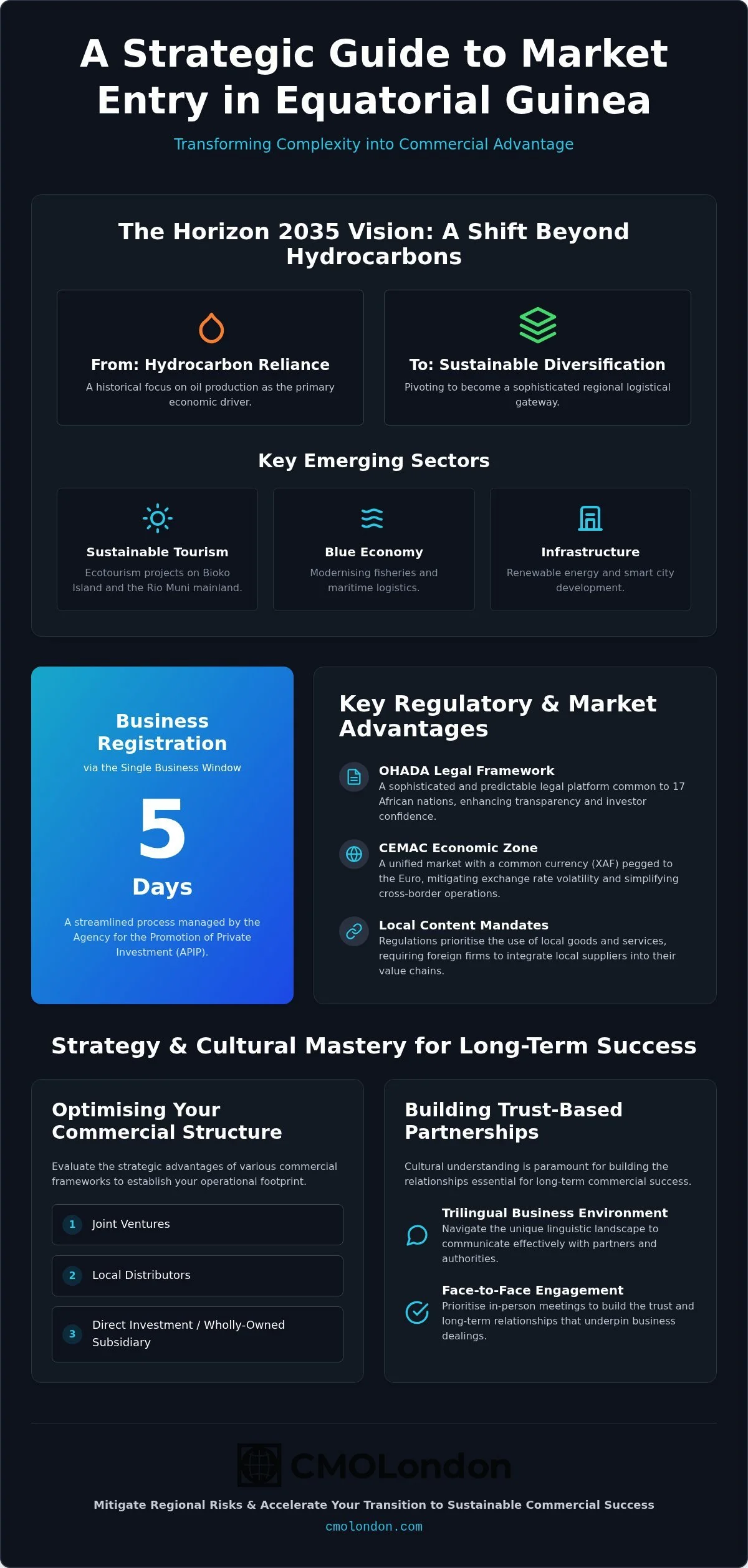
The economic narrative in Equatorial Guinea is undergoing a profound transformation. While hydrocarbons once defined the nation's wealth, the government's Horizon 2035 plan prioritises a pivot toward sustainable diversification. This shift is essential for any modern Equatorial Guinea market entry strategy. The country is no longer just an oil producer; it's positioning itself as a sophisticated regional logistical gateway. The recent launch of the National Mining and Quarrying Company in July 2026 underscores this commitment to tapping into mineral resources such as gold and bauxite to reduce oil reliance.
The implementation of the African Continental Free Trade Area (AfCFTA) is fundamentally reshaping trade dynamics. Malabo and Bata are evolving into critical maritime nodes that connect the Atlantic to the broader continent. Being part of the CEMAC zone provides a unified market with a common currency, which simplifies cross-border operations significantly. Equatorial Guinea is a maturing middle-income market with high infrastructure potential. For a deeper dive into these transitions, Equatorial Guinea's economic overview provides historical context on how the nation reached this pivotal junction.
Beyond Hydrocarbons: Emerging Sectors for UK Firms
The blue economy and sustainable tourism represent the next frontier of growth. The government is actively seeking expertise to develop its pristine coastlines whilst preserving ecological integrity. There's also a pressing need for multimodal transport solutions and energy infrastructure to link island and mainland territories efficiently. Key opportunities include:
Sustainable Tourism: Ecotourism projects on Bioko Island and the Rio Muni mainland.
Blue Economy: Modernising fisheries and maritime logistics.
Infrastructure: Renewable energy integration and smart city development in Malabo II.
Local enterprises are increasingly seeking sophisticated business process management to align with international standards. This demand creates a unique niche for strategic consulting firms that understand how to bridge the gap between global corporate expectations and Malabo's operational realities.
The CEMAC Economic Context
Currency stability remains a cornerstone of the investment climate. The Central African CFA Franc (XAF) is pegged to the Euro, which mitigates the exchange rate volatility often found in other emerging markets. Whilst neighbours like Gabon and Cameroon share this currency, Equatorial Guinea often offers more modern infrastructure per capita due to decades of targeted investment. This regional integration allows for the free movement of investment, though navigating the specific bureaucratic layers of the CEMAC zone requires a seasoned partner. Understanding these regional trade policies is vital for any successful Equatorial Guinea market entry strategy.
The Regulatory Framework: Navigating OHADA and Local Content
Equatorial Guinea's regulatory landscape is anchored by the Organisation for the Harmonisation of Business Law in Africa (OHADA). This membership provides a sophisticated and predictable legal platform common to 17 African nations, which significantly simplifies the legal aspects of an Equatorial Guinea market entry strategy. Throughout 2026, OHADA has actively reformed its governance structures to enhance transparency and financial sustainability, ensuring that international investors operate within a framework that meets global standards. Central to this environment is the Agency for the Promotion of Private Investment (APIP), which manages the "Single Business Window" to expedite the registration process for new commercial entities.
Compliance in 2026 requires a deep understanding of the government's local content mandates. These regulations prioritises the use of local goods and services, particularly within the hydrocarbons and mining sectors. Whilst the specific percentages are often defined within individual production-sharing contracts, the overarching policy demands that foreign firms demonstrate a clear commitment to integrating local suppliers into their value chains. Navigating these requirements effectively involves more than simple box-ticking; it requires a genuine engagement with the domestic economy. For a broader perspective on the operational hurdles, the U.S. Department of State's Investment Climate Statement offers an authoritative overview of the legal and political nuances facing international stakeholders.
Compliance and Legal Structures
Investors typically choose between a Société à Responsabilité Limitée (SARL) or a Société Anonyme (SA). A SARL requires a minimum share capital of XAF 1,000,000 and is often the preferred vehicle for smaller to medium enterprises. Conversely, the SA structure is better suited for larger capital-intensive projects. The fiscal environment has become notably more attractive; as of January 2025, the corporate income tax rate was reduced from 35% to 25%. However, firms must remain mindful of the 1.5% minimum income tax on turnover. Partnering with experts in strategic consulting management can help you navigate these tax nuances whilst ensuring your profit repatriation strategies remain compliant with CEMAC’s foreign exchange regulations.
Labour Laws and Local Employment
The Ministry of Labour enforces strict guidelines regarding the employment of expatriates. Work permits are contingent upon demonstrating that a specific role cannot be filled by a local candidate. Furthermore, companies are obligated to implement robust training and development programmes for their local workforce. These obligations are monitored closely by the National Institute of Social Security (INSESO), where employers contribute 21.5% of gross salary. Managing these industrial relations requires a nuanced approach that balances international corporate standards with local labour expectations and CEMAC guidelines.
Choosing Your Equatorial Guinea Market Entry Strategy
Selecting the right vehicle is the most critical decision in your Equatorial Guinea market entry strategy. Whilst direct investment offers total control, it often exposes British firms to the full weight of bureaucratic friction during the initial setup. Conversely, a partnership-led entry offers a cultural and operational buffer that solo ventures rarely achieve in the high-context Malabo business environment. By aligning with local interests, you don't just enter a market; you integrate into a community, which is essential for long-term commercial stability.
For firms not yet ready for a full-scale presence, establishing a representative office serves as an excellent low-risk first step. It allows you to conduct market research and build essential relationships without the immediate tax burdens of a fully incorporated SARL. Local agents and distributors can also bridge the gap, though they require meticulous vetting to ensure alignment with your brand's integrity. Whilst the U.S. Department of State Investment Climate Statement notes the complexities of the local legal system, these challenges are manageable for firms that prioritise local expertise from the outset.
The Joint Venture Model
In growth sectors like sustainable tourism, the joint venture model has proven exceptionally resilient. Success here depends on identifying partners who possess both technical competence and existing government relations. Agreements must be structured with precision to protect your equity and intellectual property whilst satisfying local content mandates. This collaborative approach doesn't just share risk; it creates a shared vision that resonates with local stakeholders and regulators alike, turning potential obstacles into shared objectives.
Strategic Consulting and Project Direction
Navigating the pre-entry phase requires more than just a business plan. It demands professional Project Direction to ensure commercial outcomes align with local timelines. In the Central African context, delays are often a symptom of miscommunication rather than malice. Bespoke advisory through Strategic Consulting Management helps manage these expectations, providing the on-the-ground insights needed to keep projects on track. We've found that firms which invest in professional oversight early on avoid the common pitfalls that stall unguided entrants. Our role is to act as that bridge, ensuring your strategy is both ambitious and grounded in local reality.
Cultural Mastery: The Key to Long-term Commercial Success
While technical and legal frameworks provide the skeleton of an Equatorial Guinea market entry strategy, cultural intimacy provides the lifeblood. In Malabo, commercial transactions are rarely viewed as isolated events; they are milestones within an ongoing relationship. The concept of "presence" is paramount. Attempting to manage a market entry from a distance often leads to misunderstandings or stalled progress. Face-to-face engagement remains the gold standard for negotiation, allowing stakeholders to gauge integrity and commitment in ways that digital communication cannot replicate.
The linguistic landscape of Equatorial Guinea is equally distinctive. As the only Spanish-speaking nation in Sub-Saharan Africa, it offers a unique bridge for international firms, yet the official recognition of French and Portuguese reflects its deep integration into the CEMAC and Lusophone worlds. Navigating this trilingual environment requires more than just translation; it requires an appreciation for the subtle shifts in tone and protocol that each language carries. Decision-making within government ministries follows a rigorous hierarchy. Understanding who holds formal authority versus who wields informal influence is a skill that only comes with local proximity and time.
Relationship-Based Commerce
High-level business meetings in Malabo are characterised by a "partnership-oriented warmth" that balances formal etiquette with genuine personal interest. It's common for initial discussions to focus on shared values and background before turning to commercial specifics. Distinguishing between formal protocol and the informal networks of influence is vital. Success often hinges on your ability to navigate these layers with grace, respecting the established order whilst building the trust necessary to move projects forward. This cultural fluency is what separates a fleeting venture from a lasting commercial presence.
Sustainable Impact as a Business Asset
Modern investors are increasingly judged by the legacy they leave behind. Aligning your business objectives with local growth, particularly in areas like early childhood development and sustainable tourism, transforms your firm from a guest into a genuine stakeholder. This isn't merely about corporate social responsibility; it's about building a business asset that generates long-term reputational capital. When you champion community initiatives, you demonstrate a commitment to the nation’s future that resonates deeply with both the public and the government. If you are looking to secure your position through expert strategic consulting management, we can help you integrate these social impact goals into your broader commercial framework.
Partnering with CMOLondon for Equatorial Guinea Business Consulting
Entry into the CEMAC region requires more than just capital; it demands a partner who understands the rhythm of local commerce. Elizabeth Traore-Andony brings 12 years of specialised mastery to every engagement, providing the deep-rooted stability necessary to navigate Malabo's unique landscape. Our firm serves as a dedicated conduit, ensuring that your Equatorial Guinea market entry strategy is informed by on-the-ground reality rather than distant assumptions. We don't just advise; we guide you through the intricate layers of regional regulations and local content mandates with the confidence of a seasoned veteran.
Through bespoke Business Process Management, we align your international expansion goals with the operational requirements of the region. Our Project Direction services are designed to bridge the physical and cultural distance between the United Kingdom and Central Africa, providing the oversight needed to ensure that strategic milestones are met without compromise. We translate complex regional realities into actionable commercial pathways, allowing your board to make informed decisions with absolute clarity. This proximity allows us to manage bureaucratic friction before it impacts your timeline.
Our Strategic Approach
We follow a methodical progression that moves from broad global perspectives to highly localised expertise. This approach ensures that your Equatorial Guinea market entry strategy remains resilient against regional volatility whilst maximising the commercial opportunities presented by the nation's economic diversification. Integrity and long-term value creation are at the heart of our methodology. We believe that sustainable success is built on a foundation of mutual trust and social impact, a philosophy that informs every stage of our implementation process. We act as your eyes and ears on the ground, ensuring your legacy is as strong as your balance sheet.
Contact CMOLondon for Your Market Entry Strategy
Transitioning from strategic analysis to on-the-ground implementation is a journey that requires a sophisticated bridge-builder. We invite you to arrange an executive briefing for your board to discuss how our rare insights can facilitate your commercial objectives. Our team is ready to provide the high-level strategic confidence and cultural intimacy your expansion deserves. Enquire about our Strategic Consulting Management services today to begin your journey toward mastery in the Central African market.
Securing Your Commercial Legacy in Central Africa
Equatorial Guinea's pivot toward economic diversification presents a rare window for firms that prioritise precision over speed. By aligning your operations with OHADA standards and the government’s 2035 vision, you transform regulatory hurdles into sustainable competitive advantages. Success in this trilingual market ultimately rests on building trust through face-to-face engagement and demonstrating a genuine commitment to local growth. These cultural nuances are the foundation upon which resilient commercial structures are built.
A robust Equatorial Guinea market entry strategy requires a sophisticated blend of formal compliance and cultural fluency. With 12 years of CEMAC market experience, CMOLondon specialises in building the UK-Africa trade bridges that ensure your project direction leads to long-term success. We act as your wise guide, navigating the intricate bureaucracy of Malabo whilst you focus on your core commercial objectives. Secure your strategic entry with CMOLondon’s expert consultancy and take the first step toward a resilient partnership in one of Africa's most promising markets. The road to commercial mastery is complex, but with the right guidance, it's a path paved with significant opportunity.
Frequently Asked Questions
Is Equatorial Guinea a safe place for British business investment in 2026?
Equatorial Guinea remains a stable environment for British investment, particularly as the government pursues its Horizon 2035 diversification goals. The country’s upper-middle-income status and the pegging of the CFA Franc to the Euro provide a level of fiscal predictability rare in the region. Whilst bureaucratic layers exist, the move toward a "Single Business Window" demonstrates a clear commitment to improving the investment climate for international stakeholders.
What are the main challenges of the Equatorial Guinea market entry strategy?
The primary hurdles within an Equatorial Guinea market entry strategy involve navigating bureaucratic opacity and the high-context nature of local business relations. Investors often struggle with identifying vetted local partners and understanding the nuances of OHADA regulations. These complexities require a strategy that balances formal compliance with informal relationship management. Success depends on having a grounded, realistic acknowledgement of these regional intricacies rather than relying on global templates.
Do I need a local partner to register a business in Equatorial Guinea?
Whilst OHADA law allows for 100% foreign ownership in many sectors, local content regulations often make a domestic partner a strategic necessity. For a Société à Responsabilité Limitée (SARL), the minimum share capital is XAF 1,000,000. Even when not legally mandated, a reliable local partner provides the cultural intimacy and existing governmental relations required to navigate the registration process and subsequent operational phases effectively.
How does the CEMAC region affect trade for UK companies?
Membership in the CEMAC zone offers UK companies access to a unified regional market with a common currency, the Central African CFA Franc. This integration facilitates the free movement of investment and simplifies cross-border trade with neighbours like Gabon and Cameroon. However, it also means that firms must comply with regional financial regulations and governance structures, which were recently updated in mid-2026 to enhance transparency and financial sustainability.
What language is used for business in Equatorial Guinea?
Spanish is the primary language for business and administration, reflecting the nation's unique heritage in Sub-Saharan Africa. However, French and Portuguese are also official languages, facilitating trade within the CEMAC and Lusophone zones. For British firms, this trilingual environment necessitates a high level of linguistic fluency or the support of a consultant who can bridge these communication gaps during high-level negotiations and ministerial meetings.
What is the local content requirement for new businesses in the energy sector?
Local content requirements in the energy sector are rigorous, with regulations often mandating that a specific percentage of goods and services be sourced domestically. Whilst these figures are frequently defined within individual production-sharing contracts, there is a clear government enforcement of these rules to ensure economic diversification. Firms must demonstrate a commitment to training the local workforce and integrating domestic suppliers into their broader corporate value chain.
How long does it typically take to set up a business in Malabo?
The implementation of the "Single Business Window" has officially reduced the time required for business registration from 33 days to just five days. Despite this improvement in the formal process, the broader setup including tax registration and work permit procurement can take several months. A successful Equatorial Guinea market entry strategy accounts for these secondary timelines by ensuring all documentation is meticulously prepared before the initial submission.
How can CMOLondon assist with project direction in Central Africa?
CMOLondon provides expert Project Direction by leveraging Elizabeth Traore-Andony’s 12 years of mastery in the CEMAC region. We act as a sophisticated bridge, managing complex business processes and ensuring that commercial outcomes align with local realities. Our firm facilitates global trade connections whilst championing sustainable growth, allowing UK investors to navigate the transition from potential misunderstanding to total commercial clarity with absolute confidence.