
Central Africa Market Entry Strategy: 2026 UK Guide

What if the perceived risks of the CEMAC region are actually the very barriers protecting your most lucrative untapped opportunities? While many British boards hesitate at the mention of OHADA regulations or regional volatility, the most astute organisations are already positioning themselves to capitalise on a market where Cameroon’s GDP is projected to grow by up to 4.5% in 2026. Developing a robust Central Africa market entry strategy for UK companies requires more than just a cursory glance at trade statistics; it demands a sophisticated blend of cultural intimacy and rigorous project direction.
You likely recognise that the complexity of local tax laws and the search for reliable partners can feel like an insurmountable hurdle to sustainable growth. This guide provides a definitive roadmap to master these intricacies, transforming regional potential into a de-risked commercial reality. We will explore the latest 2026 regulatory reforms, the nuances of the CEMAC tax landscape, and how expert business process management can bridge the gap between global strategy and local execution. By the end of this brief, you will possess the clarity needed to turn Central African complexity into a strategic advantage.
Key Takeaways
Understand the strategic significance of the CEMAC zone and why nations such as Gabon and Cameroon are essential for UK firms seeking post-Brexit market diversification.
Master the complexities of the OHADA regulatory framework to confidently navigate the legal landscape and mitigate initial entry risks.
Identify the most suitable commercial vehicle for your expansion whilst developing a robust Central Africa market entry strategy for UK companies.
Follow a professional five-step roadmap designed to transition your organisation from initial strategic discovery to full operational readiness.
Discover how continuous project direction and business process management safeguard your interests and ensure long-term commercial viability in the region.
Table of Contents
The CEMAC Opportunity: Why UK Firms are Prioritising Central Africa in 2026
Navigating the Regulatory Landscape: OHADA and Regional Compliance
Strategic Entry Models: Choosing the Right Vehicle for Expansion
The CEMAC Opportunity: Why UK Firms are Prioritising Central Africa in 2026
Central Africa is often viewed through a lens of caution; however, for the discerning executive, the CEMAC region represents one of the most compelling growth stories of 2026. This economic bloc, comprising Gabon, Cameroon, Chad, the Central African Republic, Equatorial Guinea, and the Republic of Congo, is transitioning away from traditional extractive models toward a more diversified, resilient economy. For British firms, this shift isn't just a possibility; it's a strategic necessity. A Central Africa market entry strategy for UK companies is now a cornerstone of post-Brexit trade diversification, offering access to markets that value the integrity and technical excellence associated with British professional services.
Whilst headlines often focus on regional instability, the ground reality reflects a concerted effort toward governance reform and infrastructure development. Key sectors such as sustainable tourism, infrastructure, and global trade facilitation are expanding rapidly. Cameroon, for instance, is projected to see GDP growth of up to 4.5% in 2026. This growth is not accidental; it's the result of systemic improvements in how these nations engage with global partners. By looking past the perception gap, UK organisations can find a landscape eager for the sophisticated project direction and strategic consulting management that British firms provide.
Understanding the Unified Market Dynamics
The CEMAC zone provides a level of financial predictability that is rare in emerging markets. This stability is underpinned by the CFA franc, a common currency pegged to the Euro, which significantly reduces exchange rate risk for international investors. By 2026, the region is expected to function as a 50-million-strong consumer market, bolstered by the removal of internal trade barriers amongst member states. This integration allows for regional value-chain strategies rather than fragmented, country-specific approaches. It's a unified ecosystem where informed decision-making can yield sustainable commercial results.
The UK-Central Africa Trade Corridor
UK firms are uniquely positioned to meet the region's burgeoning appetite for high-level expertise in project management and strategic consulting management. Under the "Global Britain" framework, trade relations are strengthening; total trade between the UK and Cameroon alone reached £242 million in the year ending Q1 2026. Navigating this corridor requires a deep understanding of the OHADA legal framework, which harmonises business law across 17 African nations. Mastery of these regulations, combined with CMOLondon’s on-the-ground mastery of business process management, ensures that UK interests are protected whilst capitalising on local opportunities. Success here depends on moving beyond generic consulting into a partnership-oriented model that respects local cultural nuances whilst maintaining international standards of excellence.
Navigating the Regulatory Landscape: OHADA and Regional Compliance
Mastering the legal intricacies of the CEMAC zone is often the most significant hurdle for British boards. The Organisation for the Harmonisation of Business Law in Africa (OHADA) provides the primary framework, yet its Civil Law roots can feel opaque to those accustomed to UK Common Law. A successful Central Africa market entry strategy for UK companies hinges on more than just acknowledging these rules; it requires a deep, strategic mastery of their application within local contexts. Without this, even the most promising commercial venture can stall due to administrative friction or regulatory misunderstanding.
Regulatory mastery is not merely about ticking boxes. It involves building a bridge between international standards and regional requirements. Our approach to strategic consulting management ensures that your organisation doesn't just comply with the letter of the law but understands the underlying administrative culture. This cultural intimacy allows for smoother government relations and a more predictable path to operational stability. By treating compliance as a strategic asset rather than a bureaucratic burden, UK firms can secure a significant competitive advantage in the region.
Mastering OHADA Business Law
The OHADA framework is built upon "Uniform Acts" that govern everything from general commercial law to the registration of companies. These acts provide a secure, predictable legal environment that is essential for protecting UK interests. Significant updates, such as the financial regulation reforms adopted on 27 July 2026, have introduced programme-based budgeting and Results-Based Management (RBM) to enhance transparency. These shifts align the region more closely with international accounting standards, yet they require specialised knowledge to navigate. Should disputes arise, the Common Court of Justice and Arbitration (CCJA) provides a robust regional mechanism for resolution, offering a level of security that mitigates the perceived risks of expansion.
Linguistic and Cultural Fluency
Expansion into the CEMAC zone requires navigating French-speaking administrative systems whilst maintaining the high standards of a UK-listed or private firm. This linguistic barrier often masks the subtle nuances of local government relations. CMOLondon acts as both a professional and linguistic bridge, translating complex administrative requirements into actionable strategic insights for British boards. We provide the proximity and cultural fluency needed to interpret local behaviours and expectations. This ensures that your Central Africa market entry strategy for UK companies remains grounded in reality, allowing you to build long-term trust with local stakeholders without sacrificing your corporate identity or operational integrity.
Strategic Entry Models: Choosing the Right Vehicle for Expansion
Selecting the appropriate legal and commercial vehicle is the pivot point where a Central Africa market entry strategy for UK companies moves from high-level theory to operational execution. This decision requires a balanced assessment of risk appetite, tax obligations, and long-term commercial goals. Rather than adopting a generic approach, British boards must evaluate whether a permanent presence or a collaborative partnership best serves their specific objectives within the CEMAC zone. Success here is found in the details; it’s about choosing a structure that provides both the flexibility to grow and the rigidity to protect your core assets.
Bespoke advisory is essential because the "best" model is entirely dependent on your industry and intended scale. Whilst some firms require the deep roots of a subsidiary, others may find that a more agile entry model allows for faster market penetration with lower initial overheads. Strategic consulting management plays a vital role in this phase, helping you weigh the technical merits of each vehicle against the practical realities of the Central African business environment. It’s about ensuring that your chosen model doesn't just look good on a balance sheet but functions effectively on the ground.
Subsidiary vs. Branch Office
The choice between a subsidiary and a branch office often comes down to the desired level of liability protection. A subsidiary, typically established as a Limited Liability Company (SARL) or a Public Limited Company (SA), creates a separate legal entity under OHADA law. This structure isolates the UK parent company from local liabilities, which is a significant advantage in a region where regulatory shifts can be unpredictable. In Cameroon, for instance, a SARL requires a minimum share capital of approximately US$1,900. Whilst this offers protection, it also subjects the entity to local corporate tax rates, which can reach an effective rate of 33%.
A branch office, by contrast, is an extension of the UK parent firm. This model is often favoured for short-term projects or initial market testing because it involves a simpler registration process. However, it exposes the parent company to direct legal and financial liabilities. Mastering these nuances is a core component of a robust Central Africa market entry strategy for UK companies, ensuring that your corporate architecture is built for resilience.
The Strategic Partnership Model
For many UK firms, the most effective route to market mastery is through a strategic local partnership or joint venture. This model provides immediate access to established networks and the cultural intimacy necessary to navigate local government relations. The challenge, however, lies in identifying and vetting partners who align with UK compliance standards and ethical expectations. This is where Project Direction and Business Process Management become indispensable tools. By implementing these rigorous frameworks, you can maintain operational control and visibility from the UK, ensuring that your local partners adhere to your strategic vision whilst they handle the day-to-day intricacies of regional trade.
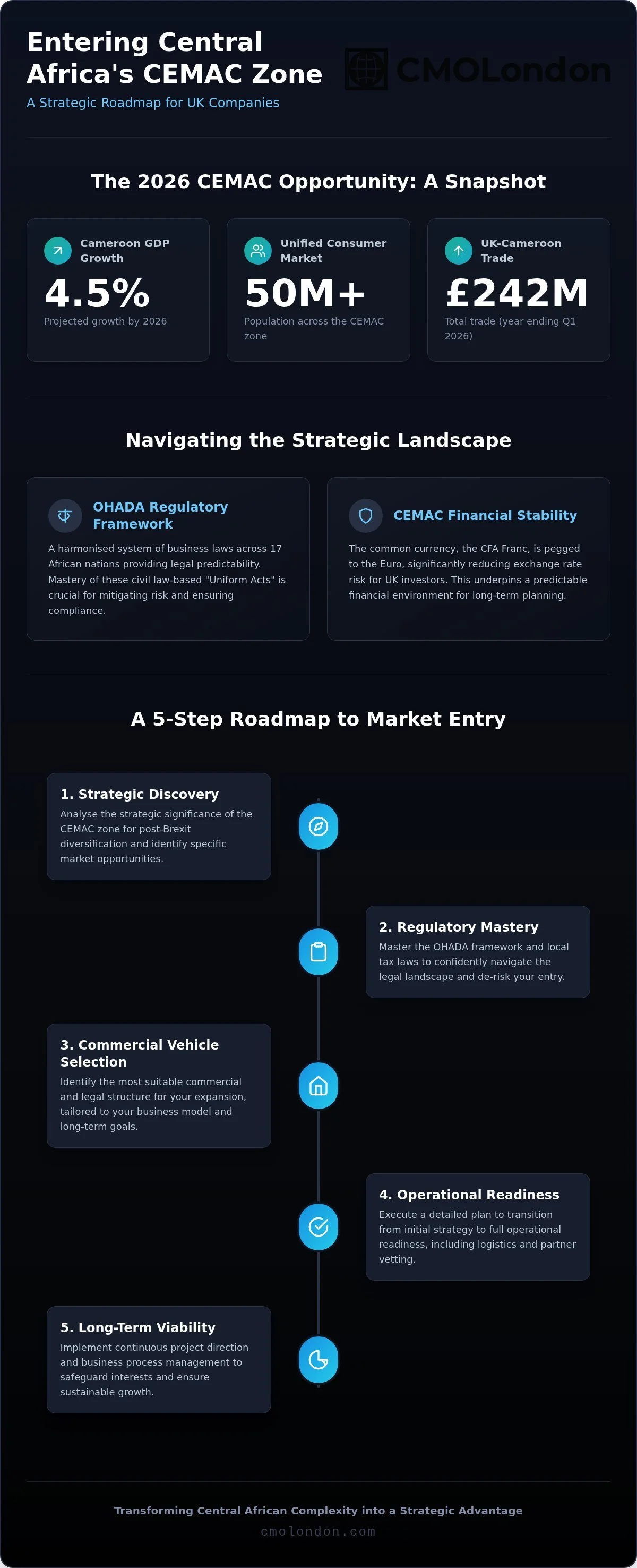
A 5-Step Roadmap for a Successful Market Entry
Successful expansion into the CEMAC zone requires more than a simple checklist; it demands a methodical progression that respects both the scale of the opportunity and the intricacy of the environment. A comprehensive Central Africa market entry strategy for UK companies is built upon five foundational pillars designed to transition your organisation from initial interest to a sustainable commercial presence. This roadmap ensures that every action is grounded in informed decision-making rather than reactive impulse, allowing you to build a bridge between London and Central African markets with confidence.
Step 1: Market Readiness and Strategic Discovery. Assess internal capabilities against regional demands and cultural expectations.
Step 2: Regulatory Mapping and Legal Structuring. Define the OHADA-compliant vehicle that best protects your UK assets.
Step 3: Local Stakeholder and Partner Engagement. Build trust through carefully vetted regional networks and government relations.
Step 4: Operational Setup and Process Optimisation. Implement robust local workflows that mirror your global standards.
Step 5: Continuous Project Direction and Risk Mitigation. Maintain high-level oversight to ensure long-term agility and compliance.
Phase 1: Discovery and Structuring
Before any physical office is opened or contract signed, brand discovery must precede all other activities. This phase involves a deep dive into how your UK corporate identity translates into a Central African context. It's about aligning your global objectives with the specific market realities of nations like Gabon or Cameroon. You must ensure your value proposition resonates whilst respecting local cultural nuances. This alignment is not merely a branding exercise; it's the bedrock of your commercial integrity in the region. Without this initial clarity, the risk of strategic drift increases significantly once physical operations begin.
Phase 2: Execution and Oversight
Once the legal structure is established, the focus shifts to the rigour of execution. This is where Business Process Management becomes critical, ensuring that your operations remain efficient, transparent, and compliant with both UK and CEMAC standards. However, implementation is not a "set and forget" activity. Continuous Project Direction is required to monitor progress against your bespoke strategy, providing the necessary mechanisms to navigate unforeseen challenges. This high-level oversight acts as your eyes and ears on the ground, protecting your interests whilst you scale. To begin crafting your tailored roadmap, consider engaging our strategic consulting management services to ensure your entry is as seamless as it is profitable.
Beyond Entry: Ensuring Longevity through Project Direction
The true test of a Central Africa market entry strategy for UK companies lies not in the initial ribbon-cutting, but in the months and years that follow. Many organisations treat entry as a singular event, yet the CEMAC region’s dynamic nature requires a shift from static planning to active Project Direction. This continuous service acts as a safeguard for British interests on the ground, ensuring that the strategic vision established in London remains aligned with the operational realities of Central Africa. It's about moving beyond the role of a one-off consultant to becoming a long-term strategic partner that possesses the cultural intimacy required for sustained success.
CMOLondon leverages over a decade of experience to manage the intricacy of remote operations. Our mastery of Business Process Management allows us to bridge the gap between global headquarters and local subsidiaries, providing a level of proximity that outsiders often lack. By maintaining a steady, methodical rhythm of oversight, we ensure that your commercial objectives are met whilst navigating the subtle shifts in the regional landscape. This dedicated presence transforms potential uncertainty into a state of mastery, allowing your firm to carry itself with the confidence of a seasoned veteran.
Managing Operational Complexity
Operational pitfalls, such as supply chain delays or sudden regulatory shifts, can quickly erode the gains of a successful launch. Project Direction mitigates these risks by providing a "Wise Guide" who maintains vital local government relations and anticipates administrative friction before it impacts your bottom line. For instance, the transition to International Public Sector Accounting Standards (IPSAS) across the CEMAC zone in 2026 requires continuous technical oversight to ensure reporting remains compliant. Having an elite expert who understands these nuances ensures that your organisation doesn't just survive the first year but builds a foundation for deep-rooted stability.
Sustainable Growth and Corporate Responsibility
In the Central African context, commercial success is increasingly inseparable from sustainable development. A values-driven Central Africa market entry strategy for UK companies integrates social impact as a core component of its commercial identity. At CMOLondon, we champion initiatives such as early childhood development and sustainable tourism alongside traditional trade facilitation. This approach isn't merely philanthropic; it's a strategic tool for building deeper trust with local stakeholders. When a British firm demonstrates a commitment to the region's long-term prosperity, it secures a level of cultural fluency and respect that transcends simple transactional relationships. This integrity, led by specialists like Elizabeth Traore-Andony, ensures that your presence is welcomed and your growth is genuinely sustainable.
Master Your Expansion into the CEMAC Zone
The path to commercial success in Central Africa is defined by a transition from broad potential to precise, ground-level mastery. We've explored how a robust Central Africa market entry strategy for UK companies must integrate the legal rigour of the OHADA framework with the cultural intimacy required to navigate local administrative systems. By selecting the correct commercial vehicle and maintaining continuous oversight through dedicated Project Direction, your organisation can transform regional complexities into a stable, sustainable advantage.
CMOLondon serves as the essential bridge between UK corporate standards and the unique realities of the CEMAC zone. With over 10 years of mastery in the region, we provide the strategic consulting management and on-the-ground presence needed to protect your interests whilst you scale. You don't have to navigate this intricate landscape alone; instead, you can rely on a partner who understands both the technical requirements and the human relationships that drive trade.
Secure your position in Central Africa with CMOLondon’s expert Project Direction and turn your 2026 expansion goals into a flourishing commercial reality. The opportunities within the region are vast, and with the right guide, your success is well within reach.
Frequently Asked Questions
What are the main trade barriers for UK companies in the CEMAC region?
The primary barriers include opaque regulatory frameworks and the challenge of identifying reliable local partners within the CEMAC zone. British firms often struggle with the transition from Common Law to the OHADA system. Additionally, logistical complexities and the requirement for pre-shipment inspections on imports valued over approximately US$3,300 in Cameroon can create administrative friction. Strategic consulting management helps mitigate these hurdles by providing a clear, de-risked roadmap through these regional intricacies.
How does OHADA law protect British investors in Central Africa?
OHADA law provides a harmonised legal framework across 17 African nations, ensuring that commercial contracts and company registrations follow a predictable, unified set of Uniform Acts. This legal certainty is vital for protecting UK interests, as it provides access to the Common Court of Justice and Arbitration (CCJA). By using these regional mechanisms, British investors can resolve commercial disputes in a secure environment that aligns more closely with international business standards and transparency.
Is it necessary to have a local partner to enter the Gabon or Cameroon markets?
Whilst it's not always a legal requirement to have a local partner when establishing a subsidiary like a SARL, having one is often essential for navigating local government relations and cultural nuances. A partner provides the cultural intimacy needed to accelerate market penetration and build long-term trust with stakeholders. CMOLondon acts as a bridge in this process, helping you vet potential partners whilst ensuring your Central Africa market entry strategy for UK companies remains fully compliant.
How long does it typically take to register a business in the CEMAC zone?
The timeline for business registration varies across the member states but generally spans from a few weeks to several months. In Cameroon, for example, the process involves name reservation and registration for a legal person, which can be streamlined through digital solutions like the "Douane CMR" app. Utilising business process management ensures that all documentation is meticulously prepared, preventing the administrative delays that often occur when foreign firms attempt to navigate the registration landscape alone.
What is the role of the CFA franc in Central African business transactions?
The CFA franc serves as the common currency for the CEMAC region and is pegged to the Euro, providing a significant level of financial stability and predictability. This arrangement reduces exchange rate risk for UK companies, making it easier to manage cross-border transactions and profit repatriation. Understanding this monetary framework is a core part of any Central Africa market entry strategy for UK companies, as it underpins the region's broader economic integration and growth.
How can UK firms manage the risk of political instability in the region?
Managing political risk requires a shift from distant observation to active, on-the-ground project direction. By maintaining a continuous presence and leveraging deep-rooted stability, firms can anticipate shifts in the political landscape before they impact operations. We provide a de-risked roadmap that focuses on building diversified regional value chains rather than relying on a single market. This strategic approach ensures that your commercial interests are protected through informed decision-making and a grounded, realistic acknowledgement of complexities.
Can CMOLondon assist with government relations in Central Africa?
We provide comprehensive support for government relations through our strategic consulting management and project direction services. Our team acts as a sophisticated bridge-builder, facilitating dialogue between British boards and Central African administrative bodies. With over a decade of mastery in the CEMAC zone, we possess the rare, on-the-ground insights needed to navigate local bureaucracies. We help you build mutual understanding and long-term trust with stakeholders, ensuring your operations remain aligned with regional governance standards.
What sectors are currently seeing the highest growth in Central Africa?
High growth is currently concentrated in sustainable tourism, infrastructure, and agribusiness, as CEMAC nations look to diversify beyond traditional extractives. Digital infrastructure and renewable energy are also seeing increased investor interest as the region modernises. Gabon is expected to lead with a projected growth of 3.7% in 2026, whilst Cameroon's GDP is forecast to rise by up to 4.5%. These sectors offer significant opportunities for UK firms that can provide high-level technical expertise and project management.