
Developing a Robust CEMAC Trade Compliance Strategy for 2026

Most UK firms view the January 2026 harmonisation of Central African customs as a daunting barrier, yet for the prepared, it's actually the most significant competitive advantage available in the region. You likely feel the weight of opaque procedures and the constant worry that a single administrative oversight could stall your entire supply chain. Managing remote operations across multiple borders is inherently complex; the fear of unexpected fines under OHADA regulations is a reality many leaders face. We understand that the transition to the new Harmonized ECCAS-CEMAC Customs Code feels like a moving target whilst you're trying to maintain momentum.
This guide will help you master these complexities by providing a sophisticated CEMAC trade compliance strategy designed specifically for the UK business context. You'll gain a clear, repeatable framework to navigate the evolving regulatory landscape, from the new foreign exchange repatriation rules to mandatory digital declarations. We'll outline how to transform your compliance from a source of anxiety into a streamlined process that reduces border delays and ensures your operations remain beyond reproach. By the end of this article, you'll have the strategic confidence to lead your firm through the intricacies of the 2026 market with absolute clarity.
Key Takeaways
Understand how the 2026 harmonisation of regional customs codes creates new opportunities for UK firms to streamline their cross-border operations.
Establish a robust CEMAC trade compliance strategy that balances global standards with local regulatory nuances to eliminate administrative delays.
Master the complexities of the Common External Tariff whilst integrating rigorous due diligence processes for all Central African partners and agents.
Identify and mitigate operational bottlenecks through comprehensive risk assessments and end-to-end supply chain mapping tailored for the regional market.
Leverage strategic consulting management to bridge the gap between UK corporate expectations and the intricate realities of the CEMAC zone.
Table of Contents
Navigating the CEMAC Customs and Compliance Landscape
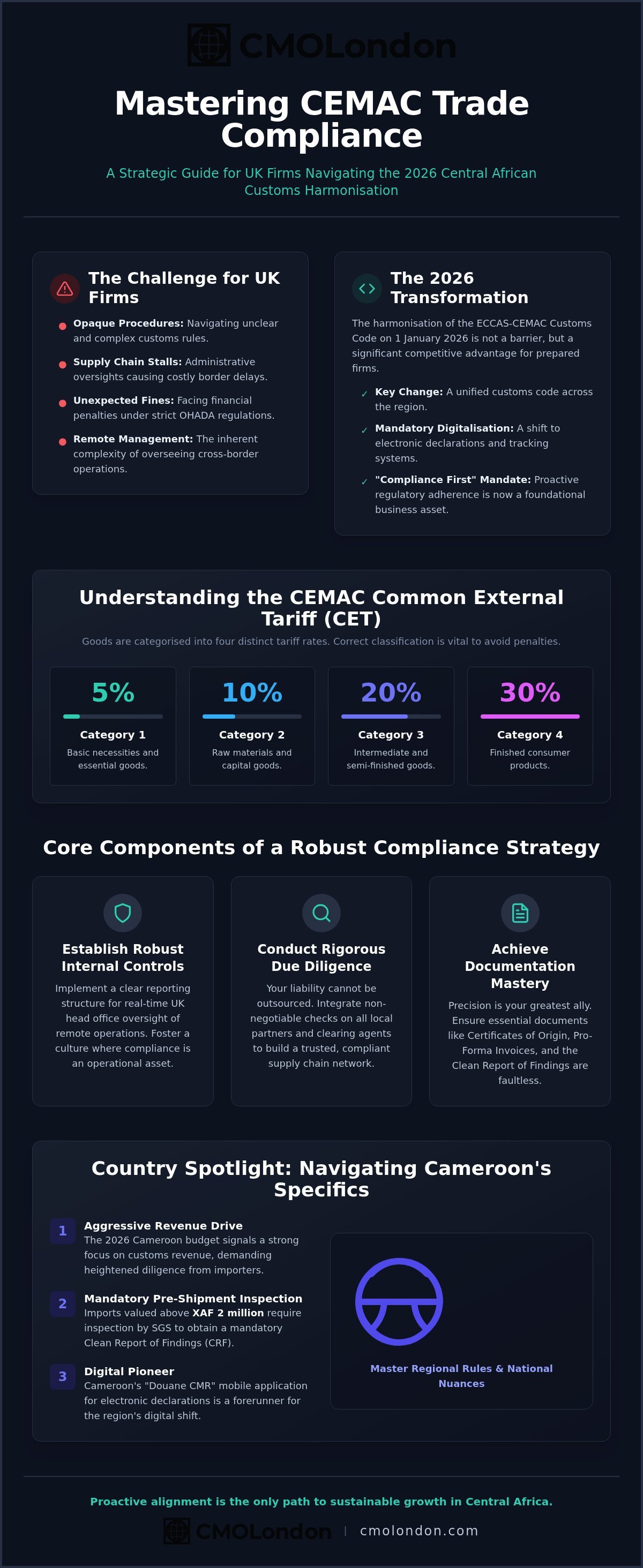
A robust CEMAC trade compliance strategy serves as a holistic framework for managing cross-border movement, tariffs, and legal obligations amongst the six member states of the Economic and Monetary Community of Central Africa (CEMAC). It's more than a simple checklist. It's a strategic pillar that ensures UK businesses can navigate the Common External Tariff (CET) which categorises goods into four distinct rates ranging from 5% for basic necessities to 30% for consumer products. For exporters, understanding these classifications is vital to avoiding the punitive costs of misdeclaration or incorrect valuation. Beyond customs, the OHADA regulatory framework governs corporate behaviour across the zone. It provides a unified legal structure that demands rigorous adherence to transparency, commercial law, and accounting standards. Whilst some investors historically preferred a "wait and see" approach, the implementation of the Harmonized ECCAS-CEMAC Customs Code on 1 January 2026 makes such passivity a significant risk to your market viability. Sophisticated firms recognise that proactive alignment is the only path to sustainable growth.
The Reality of Central African Trade Barriers
Operational hurdles often manifest as documentation discrepancies or opaque valuation methods that can stall shipments indefinitely. You'll find that regional infrastructure, whilst improving through significant investment, still dictates your compliance timelines. A delay at a port isn't just a logistical issue. It's a compliance risk that tests the strength of your internal controls and partner relationships. Success requires a dual focus. You must respect the regional CEMAC rules whilst simultaneously mastering national specificities in markets like Cameroon. For instance, the 2026 Cameroon budget of 8,683.9 billion CFA francs signals an aggressive drive for customs revenue. This means imports valued above XAF 2 million must undergo strict pre-shipment inspection by the Société Générale de Surveillance (SGS) to obtain a mandatory Clean Report of Findings.
Regulatory Evolution: What has Changed for 2026?
Digitalisation is the defining hallmark of the 2026 landscape. Cameroon has already pioneered this shift with the "Douane CMR" mobile application for electronic declarations, and similar electronic tracking systems are now expanding across the zone to improve revenue collection and transparency. These systems increasingly align with the broader objectives of the African Continental Free Trade Area (AfCFTA), creating a more integrated, though technically demanding, environment for international trade. This evolution reflects a broader trend toward formalising employment and reducing the influence of the informal sector. The "Compliance First" mandate defines a paradigm where regulatory adherence is treated as a foundational business asset rather than a secondary administrative burden.
Core Components of a Robust Compliance Strategy
A sophisticated CEMAC trade compliance strategy isn't merely a set of rules; it's a living management system. To succeed, UK firms must establish internal controls that mirror international best practices whilst respecting the specificities of the region. This requires more than legal box-ticking. It demands a clear reporting structure that ensures your UK head office maintains real-time oversight of remote operations. When compliance culture permeates every level of your project direction, you transform a regulatory hurdle into a badge of operational excellence. This proactive stance signals to local authorities that your organisation values integrity as much as it values growth.
You cannot outsource your liability. Rigorous due diligence processes for local partners and clearing agents are non-negotiable. By integrating these checks into your standard Business Process Management, you ensure that every link in your supply chain adheres to your corporate values. It's about building a network of trusted allies who understand that non-compliance is not an option. This level of scrutiny protects your reputation and ensures that your operations remain stable amongst the shifting dynamics of the Central African market.
Documentation and Record-Keeping Mastery
Precision is your greatest ally at the border. Essential documents such as certificates of origin, pro-forma invoices, and the Clean Report of Findings must be beyond reproach. Discrepancies often lead to administrative penalties and costly delays that ripple through your entire project timeline. Maintaining a centralised digital archive isn't just about convenience; it's about audit readiness. In an era of increasing digitalisation, having immediate access to accurate historical data allows you to resolve disputes with customs authorities swiftly and professionally. Accuracy in these records is the primary defence against the opaque valuation methods that sometimes challenge international exporters.
Managing Financial and Currency Compliance
Navigating the CEMAC customs framework also involves mastering the intricacies of the BEAC (Banque des États de l'Afrique Centrale) regulations. Currency compliance is particularly sensitive. With the phased increase in foreign exchange repatriation rates, established by Instruction n°001/GR/2026, transparent transaction monitoring is essential to mitigate anti-money laundering (AML) risks. Aligning your financial reporting with OHADA accounting standards ensures that your local accounts are transparent and legally sound. This level of financial rigour builds long-term trust with regional regulators and financial institutions alike, providing a stable foundation for your CEMAC trade compliance strategy and ensuring your capital remains secure whilst working across borders.
Strategic Options: In-House Management vs. Strategic Partnerships
Choosing the right operational model is the most consequential decision in refining your CEMAC trade compliance strategy. Maintaining a dedicated in-house compliance team in Central Africa requires substantial capital and a deep commitment to local human resource management. You'll need professionals who are fluent in both the linguistic nuances of the region and the technical requirements of the new 2026 customs codes. Whilst this model provides direct oversight, it often proves inefficient for firms whose primary focus isn't logistics. The alternative is a strategic partnership that offers the same level of rigour without the fixed overheads of a permanent local department.
The Pitfalls of Unsupervised Local Agency
The risks of relying on local clearing agents without strategic oversight cannot be overstated. These agents are often transactional in nature, focusing on the immediate clearance of goods rather than long-term regulatory health. Without independent Project Direction, UK firms may find themselves inadvertently linked to unethical practices or documentation "shortcuts" that invite scrutiny from both local and international regulators. Navigating the procedural and regulatory barriers inherent in the region requires a partner who views compliance as a strategic asset. Vetting these agents through a UK-centric lens ensures that your brand's integrity remains intact across every border crossing, protecting you from the reputational damage that follows administrative fines.
Leveraging Strategic Consulting for Market Entry
Leveraging Strategic Consulting Management provides the "Sophisticated Bridge" necessary for successful market entry. A wise guide with deep-rooted cultural intimacy can navigate the unspoken complexities of the CEMAC zone that remain invisible to outsiders. This hybrid approach allows your firm to benefit from on-the-ground expertise whilst maintaining the high standards of a UK-based organisation. It transitions your team from a state of uncertainty toward a state of mastery by providing the rare insights needed to anticipate regulatory shifts before they occur.
When you assess the cost-benefit ratio, the value of bespoke advisory services becomes clear. They provide the informed decision-making tools needed to manage remote operations effectively, ensuring that your CEMAC trade compliance strategy remains robust and adaptable. By utilising a partner with over ten years of experience in Central African market entry, you ensure that your long-term presence is built on a foundation of stability and mutual trust with regional authorities.
DownloadFeedback & RecreateDelete
Step-by-Step Implementation for UK Investors
Transitioning from a high-level CEMAC trade compliance strategy to operational reality requires a methodical, phased approach. For UK investors, the journey begins with a comprehensive risk assessment of your specific target market, whether you're focusing on the industrial potential of Gabon or the established trade hubs in Cameroon. This assessment must go beyond the statutory requirements of the 2026 Customs Code to evaluate the practicalities of regional infrastructure and local political dynamics. By mapping out your end-to-end supply chain before the first shipment departs, you can identify potential compliance bottlenecks, such as the pre-shipment inspection requirements for high-value imports or the nuances of electronic tracking systems. Implementing a bespoke Business Process Management system at this stage ensures that your internal workflows are resilient enough to handle the complexities of Central African trade whilst maintaining the rigour expected by your UK board.
Phase 1: Pre-Entry Due Diligence
The success of your regional operations depends entirely on the quality of your initial intelligence. This phase focuses on identifying high-level regulatory requirements and the specific political risks associated with cross-border movement in the zone. Prioritising meticulous preparation over initial speed is the golden rule of successful CEMAC market entry. You must utilise deep market intelligence to inform your initial strategy, ensuring that every local partner and clearing agent is vetted against a standardised international due diligence framework. This proactive scrutiny prevents the "shortcuts" that often lead to administrative penalties and ensures your firm enters the market with a reputation for integrity.
Phase 2: Operational Integration
Once the foundation is laid, the focus shifts to the seamless integration of your UK standards with local execution. This involves the intensive training of local staff to ensure they understand and adopt your firm's compliance expectations. Utilising professional Project Direction services at this stage is vital to maintaining steady progress and ensuring that your strategic goals aren't lost in the daily friction of regional trade. Clear, structured communication channels between your UK headquarters and Central African teams are essential for resolving discrepancies before they escalate into border delays. This level of oversight ensures that your CEMAC trade compliance strategy remains a living document, supported by a regular audit and review cycle that adapts as regional regulations continue to evolve throughout 2026.
Mastering these operational steps is simpler with the right guidance. If you are ready to refine your regional operations, explore how our Strategic Consulting Management can provide the bridge your business needs to succeed in Central Africa.
CMOLondon: Your Partner in Strategic Trade Compliance
CMOLondon stands as the premier UK-based consultancy for firms seeking to master the complexities of the Central African market. We act as a sophisticated bridge-builder, reconciling the high-level expectations of global trade with the intricate, on-the-ground realities of the region. Under the leadership of Elizabeth Traore-Andony, our firm leverages a twelve-year track record of facilitating successful market entries for UK investors. We understand that a CEMAC trade compliance strategy is only as effective as the management framework supporting it. By providing expert Project Direction, we ensure that your commercial objectives are met whilst maintaining the rigorous standards of compliance that protect your long-term interests and reputation.
Bespoke Strategic Consulting Management
Our approach to Strategic Consulting Management is never generic. We recognise that every UK investor brings a unique set of goals and risk tolerances to the table. We tailor each compliance framework to the specific operational needs of your project, ensuring that your CEMAC trade compliance strategy is both robust and practical for remote management. Our commitment extends beyond mere transactions; we believe in building long-term partnerships rooted in mutual trust and stability. This values-driven philosophy is reflected in our dedication to sustainable tourism and early childhood development initiatives across the region. We don't just guide you through the market; we help you contribute to its growth in a meaningful and ethical way.
Ensuring Success in the Central African Zone
Navigating the intersection of regional customs and OHADA regulations requires a level of cultural and linguistic intimacy that few outsiders possess. CMOLondon provides the expert oversight needed to transform these potential barriers into a streamlined pathway for your business. By integrating Business Process Management with localised insights, we remove the uncertainty that often stalls international expansion. You can move forward with the confidence that your operations are supported by a seasoned veteran who has already navigated these paths and is now reaching back to lead others. We invite you to secure your market position and lead your firm toward a state of mastery with informed, strategic advice.
Contact CMOLondon to discuss your CEMAC trade compliance strategy and discover how our expertise can facilitate your success in 2026 and beyond.
Securing Your Strategic Advantage in Central Africa
The regulatory landscape of 2026 demands a shift from reactive problem-solving to proactive mastery. Success in the region hinges on your ability to integrate the new harmonised customs codes with a rigorous internal culture of accountability. By prioritising accurate documentation and transparent financial reporting, you transform potential barriers into a streamlined pathway for growth. A well-executed CEMAC trade compliance strategy doesn't just prevent fines; it builds the long-term trust necessary to thrive amongst diverse member states.
Navigating these intricacies requires a partner who understands the delicate balance between UK corporate standards and Central African operational realities. CMOLondon offers twelve years of specialist experience in Central Africa, providing the UK-based strategic oversight essential for mastering OHADA and CEMAC regulations. We invite you to partner with CMOLondon for expert CEMAC market entry strategy and secure your firm's position as a leader in this dynamic market. The path to regional success is clear for those who choose to lead with informed confidence and ethical rigour.
Frequently Asked Questions
What are the primary customs regulations in the CEMAC region for 2026?
Primary regulations for 2026 include the Harmonized ECCAS-CEMAC Customs Code and the Common External Tariff (CET). These instruments create a unified four-tier duty structure ranging from 5% for basic goods to 30% for luxury items. UK firms must align their CEMAC trade compliance strategy with these regional standards whilst also adhering to national finance acts. For example, Cameroon's 2026 budget signals a heightened focus on customs revenue collection through stricter digital enforcement.
How does the OHADA framework affect trade compliance for UK firms?
OHADA provides a unified legal framework that governs commercial law and accounting standards across seventeen African nations, including all CEMAC members. For UK firms, this means that corporate behaviour, contracts, and financial reporting must adhere to these specific regional statutes. Compliance isn't merely about customs; it requires a deep understanding of OHADA's transparency requirements to ensure your business remains legally sound and protected against administrative disputes or inadvertent non-compliance.
Can a UK business manage CEMAC customs compliance remotely?
Managing compliance entirely from the UK is exceptionally difficult due to the requirement for on-the-ground documentation and local banking interactions. Whilst digital tools like the "Douane CMR" app are improving accessibility, the complexity of BEAC foreign exchange repatriation rules necessitates local oversight. A hybrid model, utilising UK-based strategic consulting combined with local execution, allows firms to maintain control whilst ensuring that regional nuances and physical border inspections are handled with professional precision.
What is the role of a strategic business advisor in Central African market entry?
A strategic advisor acts as a "Wise Guide" who bridges the gap between international corporate standards and Central African realities. At CMOLondon, this involves providing Project Direction and Strategic Consulting Management to navigate opaque valuation methods and documentation hurdles. An advisor with cultural intimacy can anticipate regulatory shifts, such as the 2026 changes to extractive company repatriation rates, ensuring your entry strategy remains resilient and commercially viable over the long term.
How much do trade compliance delays typically cost in the CEMAC zone?
Whilst specific monetary values for delays aren't standardised, the impact typically manifests as administrative fines and significant supply chain disruptions. In regions where customs revenue is a primary state focus, discrepancies in documentation can lead to shipments being stalled for weeks. These delays incur demurrage fees and lost market opportunities. Proactive compliance management is the most effective way to avoid these hidden costs and ensure that your capital isn't tied up in avoidable border disputes.
Is the CFA Franc stable for long-term trade investment in 2026?
The CFA Franc maintains a fixed exchange rate with the Euro, providing a level of currency stability that is rare in emerging markets. However, investors must monitor the BEAC's tighter controls on foreign exchange. For extractive companies, repatriation requirements will increase to 50% by 2027. This stable yet regulated environment rewards firms that integrate sophisticated financial monitoring into their broader CEMAC trade compliance strategy to manage liquidity and regulatory expectations effectively.
What documentation is essential for exporting goods from the UK to Gabon or Cameroon?
Essential documentation includes certificates of origin, pro-forma invoices, and the Clean Report of Findings (CRF). For shipments to Cameroon valued above XAF 2 million, a pre-shipment inspection by the Société Générale de Surveillance (SGS) is mandatory. Additionally, the shift toward digitalisation means that air travellers and exporters must often use specific mobile applications for declarations. Accuracy in these records is vital to minimise border friction and ensure your goods clear customs without punitive delays.
How do AfCFTA regulations interact with existing CEMAC customs rules?
AfCFTA regulations are designed to complement, rather than replace, the existing CEMAC customs framework. The goal is an increasing alignment between regional trade blocs to facilitate a continental single market. For UK investors, this means that a strategy compliant with CEMAC standards often serves as a strong foundation for broader African expansion. Monitoring the phased implementation of AfCFTA protocols is essential for firms looking to leverage preferential trade terms across the wider Central African zone.