
Resilient Operations: A Checklist for Business Continuity Planning in Central Africa

In the CEMAC zone, the difference between a thriving enterprise and a shuttered operation often rests not on the strength of your capital, but on the sophistication of your foresight. You likely understand the unique weight of responsibility that comes with managing Central African operations from afar, especially whilst facing the unpredictability of local supply chains and the sudden shifts in regional regulations. It's natural to feel a sense of unease when considering how a single policy change could ripple through your project's stability. This guide offers you the opportunity to transform that anxiety into strategic mastery through a rigorous approach to business continuity planning Central Africa.
We'll provide a comprehensive, CEMAC-specific framework that ensures your presence remains secure, even amidst the complexities of OHADA regulations and shifting market dynamics. By following this structured checklist, you'll move beyond mere survival to cultivate a robust, actionable resilience strategy. We'll preview the essential steps to minimise downtime and navigate crises with the poise of a seasoned regional veteran, giving you the tools to lead your projects with unwavering confidence.
Key Takeaways
Understand the critical limitations of generic Western frameworks and why a CEMAC-specific approach is essential for regional operational stability.
Learn to integrate business continuity planning Central Africa with sophisticated leadership coaching to secure your project's human capital during disruptions.
Gain actionable insights into navigating OHADA regulations and local infrastructural dependencies to maintain steady progress despite regional shifts.
Master a structured checklist for conducting a bespoke Business Impact Analysis that identifies and mitigates risks within Central African logistics and power networks.
Discover the strategic value of expert project direction and cultural intimacy in bridging the gap between international standards and local realities.
Table of Contents
Defining Business Continuity Planning in the Central African Context
The Core Pillars of Operational Resilience in Central Africa
The Comprehensive Business Continuity Checklist for UK Investors
Partnering for Resilience: Strategic Project Direction in Central Africa
Defining Business Continuity Planning in the Central African Context
In the context of the CEMAC zone, Business continuity planning transcends the standard administrative protocols found in London or New York. It represents a sophisticated framework designed to maintain essential functions amidst the specific volatilities of the Central African market. Whilst generic Western templates often focus on cyber threats or localised weather events, they frequently fail to account for the intricate infrastructural and regulatory dependencies unique to countries like Gabon or Cameroon. It's about creating a resilient ecosystem where your business processes are robust enough to withstand the unexpected without losing momentum. True business continuity planning Central Africa requires a deep-rooted understanding of regional complexities, moving beyond simple disaster recovery to foster a culture of strategic resilience. Risk management isn't merely a compliance exercise here; it's the fundamental engine of long-term survival for any international venture.
The CEMAC Risk Landscape: Beyond the Basics
Operating within the CEMAC region demands a nuanced assessment of geopolitical stability and its direct impact on trade continuity. It isn't enough to identify risks; you must understand how they interconnect across borders. For instance, the influence of OHADA regulations provides a unified legal structure that simplifies cross-border operations, yet navigating these rules during a period of disruption requires expert business process management. Our "Sophisticated Bridge-Builder" approach focuses on cultural intimacy, ensuring that your risk management strategies are grounded in local reality rather than distant theory. This perspective allows for informed decision-making when regional supply chains face unexpected pressures or regulatory shifts. This deep-rooted stability is what distinguishes a temporary venture from a long-standing regional partner.
Why Resilience is a Strategic Priority for UK Investors
For UK investors, operational resilience is as much about protecting international reputation as it is about safeguarding physical assets. In emerging markets, the financial cost of downtime can escalate rapidly, particularly when remote management lacks the necessary on-the-ground insights to pivot quickly. A single week of interrupted operations in a Central African project can lead to significant revenue loss and a breakdown in hard-won local trust. Successful business continuity planning Central Africa acts as a vital bridge between global standards and regional execution, ensuring that your presence remains stable despite external shocks. Effective business continuity planning is the strategic necessity that secures the future of UK-Central Africa trade by transforming potential vulnerabilities into enduring competitive advantages.
The Core Pillars of Operational Resilience in Central Africa
Operational resilience in the CEMAC zone requires a significant departure from purely technical solutions. While data redundancy and cybersecurity are necessary, the true foundation of business continuity planning Central Africa lies in the strength of your human capital and the cultural intimacy of your local partnerships. It's about empowering your team to act decisively when communication lines falter or regulatory shifts occur. This human-centric approach ensures that your regional presence remains stable, regardless of external volatility. True mastery involves understanding the unwritten rules of engagement in the region, which is why we emphasise the role of a seasoned guide in our methodology. Building trust with local stakeholders is not a secondary task; it's the primary engine that keeps your operations moving forward during a crisis.
Human Capital and Executive Leadership
Securing your leadership is the first step toward enduring stability. In markets like Gabon or Cameroon, succession planning for key local personnel isn't just an administrative task; it's a strategic imperative. Executive coaching for international expansion provides your leaders with the emotional and tactical tools to manage crises effectively whilst maintaining a global perspective. We prioritise the safety and mobility of international project directors, ensuring they have the support needed to lead through uncertainty. This focus on leadership development creates a resilient core that can navigate the nuances of the regional landscape with poise. When your executives are prepared, they can transform a potential disruption into an opportunity for growth and market leadership.
Process Redundancy and Workflow Optimisation
Designing flexible business processes is essential for surviving infrastructural failures. Robust Core Pillars of Operational Resilience often depend on your ability to maintain government relations whilst primary communication channels are down. Bespoke advisory helps identify critical process bottlenecks that standard templates often overlook. Managing remote operations successfully requires a shift from rigid hierarchies to more fluid, trust-based systems. By implementing decentralised decision-making, you allow local teams to handle immediate challenges without waiting for approval from across the globe. This agility is what keeps projects on track during the economic shifts forecasted for the region in 2026. Engaging in tailored strategic consulting management allows you to build these redundancies into your daily workflow, ensuring that your projects continue to move forward even when the unexpected happens.
Navigating Infrastructural and Regulatory Dependencies
Mastering the intricacies of a Central Africa market entry strategy requires more than just capital; it demands an intimate understanding of the region's physical and legal foundations. Unlike technical frameworks that assume consistent utilities, effective business continuity planning Central Africa must account for the variability of regional power, internet, and transport networks. Relying on a single provider or route is a vulnerability that sophisticated operators cannot afford. We view these dependencies not as barriers, but as variables to be managed through informed decision-making and strategic process redundancy. Insights from World Bank business continuity planning resources highlight that regional resilience is often built on the ability to pivot when primary systems fail. By acknowledging these complexities early, you position your organisation to maintain a steady regional presence whilst others are stalled by predictable disruptions.
Supply Chain and Logistics Resilience
Developing alternative logistics routes across the CEMAC trade zone is a fundamental pillar of operational stability. Supply chain interruptions are often sudden, making it vital to manage warehousing and stock levels with precision. We recommend using local market intelligence to anticipate supply shocks before they manifest as operational halts. This proactive stance allows you to navigate regional trade barriers with agility. Whether it's managing the flow of goods through diverse corridors or ensuring that backup power systems are tested and ready, your logistics strategy must be as dynamic as the markets you serve. This level of preparation ensures that your projects don't just survive disruptions but continue to progress with minimal friction.
Compliance as a Continuity Tool
Staying ahead of CEMAC regulatory shifts is a powerful way to prevent administrative shutdowns from becoming operational crises. For instance, Gabon's Law n°005/2025 requires prior technical approval for regulated commercial activities, a detail that can halt progress if overlooked. Similarly, understanding CEMAC Regulation n°02/18 regarding foreign exchange is essential for maintaining the flow of capital and repatriating profits without delay. Navigating OHADA regulations provides a unified legal framework, yet it's the mastery of these rules that allows managers to maintain government relations even during periods of administrative transition. Regulatory mastery acts as a sophisticated buffer against market volatility, ensuring that your legal standing remains beyond reproach during times of change. By integrating compliance into your continuity strategy, you transform a potential risk into a mark of deep-rooted stability.
The Comprehensive Business Continuity Checklist for UK Investors
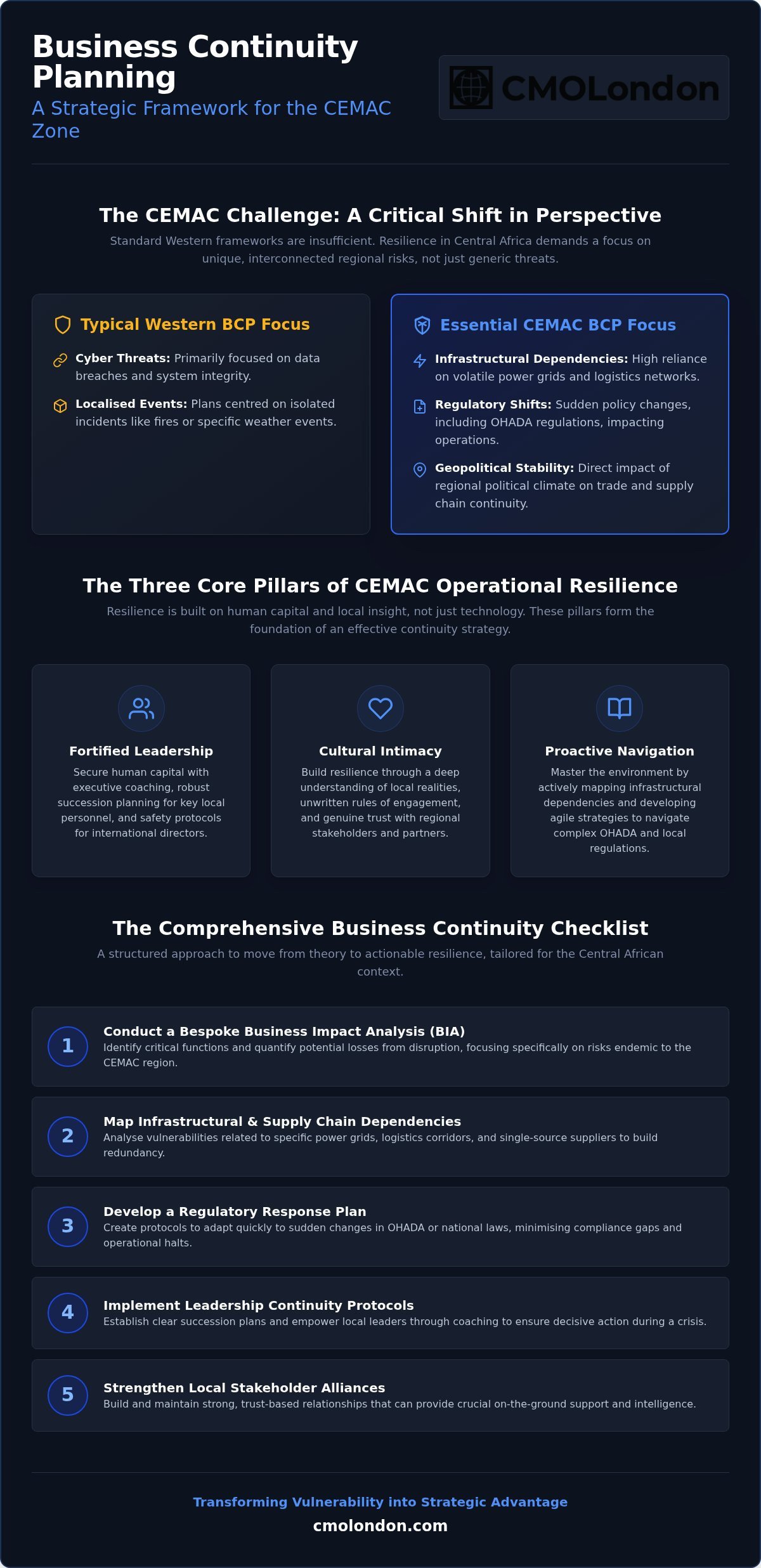
Transitioning from theoretical risk management to operational readiness requires a structured, actionable approach. For UK firms, business continuity planning Central Africa must be treated as a living document that evolves alongside regional market shifts. It isn't enough to possess a plan; you must possess a plan that is culturally and logistically calibrated for the CEMAC zone. This checklist serves as your strategic roadmap, ensuring that your regional footprint remains stable whilst others struggle with the complexities of remote management. By following these steps, you build a foundation of deep-rooted stability that protects both your assets and your international reputation.
Step 1: Conduct a CEMAC-specific Business Impact Analysis (BIA). Evaluate how regional disruptions, such as currency repatriation delays under BEAC regulations, would affect your liquidity and project timelines.
Step 2: Identify and map critical regional dependencies. Go beyond power and internet to map legal dependencies, specifically how shifts in OHADA regulations might impact your contractual obligations during a crisis.
Step 3: Develop a decentralised communication and command structure. Establish clear protocols that allow local project directors to make critical decisions when London-based headquarters are unreachable.
Step 4: Formalise stakeholder engagement protocols. Create a tiered contact list that includes local government liaisons, regional suppliers, and international trade partners to maintain transparency.
Step 5: Schedule regular stress tests. Move beyond paper-based reviews to active simulations that test your project management workflows against real-world Central African scenarios.
The Strategic Audit: Assessing Regional Vulnerability
Every UK firm must ask whether their Central African footprint relies on a "single point of failure." Often, this is a single local partner or a lone logistics corridor that, if disrupted, could halt an entire project. We believe resilience includes the personal wellbeing of your leaders. Incorporating life strategy services into your resilience plan ensures that global executives have the personal support and clarity needed to lead through high-pressure regional transitions. This audit isn't just about logistics; it's about ensuring your leadership is as robust as your business processes.
Testing and Maintenance of the BCP
The Central African landscape changes rapidly, with significant shifts expected in customs harmonisation by 2026. Your business continuity planning Central Africa must reflect these updates to remain effective. Regular simulations allow you to identify gaps in your response without halting daily operations. Professional project direction provides the necessary oversight to ensure these updates aren't just administrative, but are deeply integrated into your operational DNA. Maintaining readiness is a continuous commitment to excellence and informed decision-making.
Partnering for Resilience: Strategic Project Direction in Central Africa
Navigating the Central African market requires more than a checklist; it requires a partner who understands the rhythm of regional trade and the weight of its complexities. CMOLondon serves as a sophisticated bridge-builder, ensuring that the strategic intent of a London boardroom translates into tangible success on the ground. Whilst generic, off-the-shelf templates offer a false sense of security, true resilience is found in bespoke Strategic Consulting Management that respects local nuances and regional dependencies. We move beyond administrative compliance to provide active Project Direction, ensuring that your commercial outcomes are secured even during periods of regional transition. Our role is to provide the rare, on-the-ground insights that outsiders typically lack, turning potential vulnerabilities into enduring stability through informed decision-making.
Bridging the gap between executive intent and CEMAC reality is a delicate exercise in cultural and linguistic fluency. Successful business continuity planning Central Africa depends on the ability to anticipate how local supply chain reliability or regulatory shifts will impact your specific sector. By providing a grounded, realistic acknowledgement of regional intricacies, we help you maintain a steady regional presence. We act as your wise guide, reaching back to lead you through paths we have already successfully navigated, ensuring that your operations remain resilient and your reputation remains untarnished.
The CMOLondon Advantage in the CEMAC Zone
With over 12 years of experience in the CEMAC region, including expertise in OHADA regulations across Gabon and Cameroon, we possess a deep-rooted stability that allows us to guide our partners through complex business process management challenges. Our bespoke advisory ensures that your continuity framework is tailored to the specific risks of your industry, whether you are involved in sustainable tourism or global trade. We connect your global trade goals with sustainable regional growth, ensuring that your project remains a respected and permanent fixture in the Central African economy.
Next Steps for Securing Your Regional Future
Beginning your risk management journey starts with a realistic assessment of your current project vulnerabilities. We often recommend integrating Personal Coaching into your expansion strategy, as the personal resilience and strategic clarity of your leadership team are the ultimate safeguards against operational failure. By combining high-level strategic confidence with cultural intimacy, we help you master the intricacies of the region. To begin this transformation and secure your regional presence, Consult with our Strategic Business Advisors today.
Securing Your Regional Legacy in the CEMAC Zone
Building a resilient presence in Central Africa is an exercise in both strategic foresight and cultural intimacy. We have explored how moving beyond generic templates toward a sophisticated, CEMAC-specific framework ensures your operations remain stable despite regulatory shifts or infrastructural gaps. By prioritising human capital and decentralised decision-making, you empower your organisation to navigate the intricacies of the regional landscape with confidence. Effective business continuity planning Central Africa transforms potential vulnerabilities into enduring competitive advantages, allowing your project to thrive whilst others falter.
With over a decade of mastery in the CEMAC region and specialist knowledge in OHADA regulatory compliance, we provide the authoritative project direction necessary for successful UK-Africa trade. Our role is to act as your wise guide, bridging the gap between international standards and local realities. The path to long-term success is built on trust, informed decision-making, and a dedicated partnership. To ensure your regional future is as stable as it is ambitious, Secure your operations with a bespoke CMOLondon strategic consultation. We look forward to helping you build a legacy of resilience and growth.
Frequently Asked Questions
What is the primary risk to business continuity in the CEMAC region?
The primary risk to operational stability in the CEMAC region is the intersection of infrastructural variability and sudden regulatory shifts. This includes the strict foreign exchange regime governed by the Bank of Central African States (BEAC), which requires mandatory repatriation of export proceeds. Without a strategy to manage these financial flows, projects can face severe liquidity constraints. Preparedness involves anticipating these shifts and building redundancies into your supply chain and financial processes.
How do OHADA regulations affect business continuity planning?
OHADA regulations provide a harmonised legal framework across seventeen African nations, which simplifies business continuity planning Central Africa. However, these rules also impose specific administrative requirements during disruptions. Mastery of OHADA principles ensures that contracts remain enforceable and governance structures stay intact even when local offices face delays. It acts as a legal anchor, providing international investors with the certainty needed to maintain project momentum during periods of regional transition and administrative change.
Can a UK-based firm manage business continuity in Central Africa remotely?
Whilst a UK-based firm can provide high-level strategic direction remotely, successful continuity requires a sophisticated approach with on-the-ground insights. Managing operations purely from afar often leads to a disconnect between London executive intent and Central African reality. We recommend a hybrid model where remote leadership is supported by decentralised decision-making structures. This allows local teams to respond to immediate challenges, such as logistics bottlenecks, without waiting for approval across different time zones.
What are the most common mistakes UK companies make in Central Africa risk management?
The most frequent error is applying generic Western templates that assume consistent base infrastructure. Many UK companies also overlook the human element, failing to account for the safety and mobility of local personnel during a crisis. Another mistake is ignoring the intricacies of local market intelligence, which is vital for anticipating supply shocks. Effective risk management requires a bespoke approach that acknowledges regional complexities rather than relying on high-level, theoretical principles.
How often should a Central African business continuity plan be updated?
A Central African continuity plan should be reviewed at least annually, or whenever significant regulatory changes occur. For instance, the anticipated 2026 CEMAC customs harmonisation and the recent increases in mining royalties in the DRC necessitate immediate updates to operational strategies. Regular stress tests should also be conducted to ensure that the plan remains actionable. This consistent maintenance ensures your resilience strategy evolves alongside the dynamic market conditions and growth potential of the region.
Does business continuity planning differ between Gabon, Cameroon, and Chad?
Whilst all three nations adhere to CEMAC and OHADA rules, specific national laws create unique requirements. Gabon, for example, requires prior technical approval for regulated commercial activities under Law n°005/2025. Cameroon has distinct Corporate Income Tax rates and digital services taxes that impact financial planning. business continuity planning Central Africa must therefore account for these localised nuances to ensure full compliance and operational stability across different national jurisdictions within the Central African trade zone.
What role does executive coaching play in regional business resilience?
Executive coaching is a critical component of regional resilience, providing leaders with the emotional and tactical tools to manage projects through high-pressure transitions. It fosters the strategic clarity needed to make informed decisions when faced with sudden market volatility. By investing in the personal development of project directors, firms ensure that their leadership core is as robust as their business processes. This focus on human capital is what ultimately secures long-term trust and operational stability.
Is bespoke advisory necessary for a standard BCP in the CEMAC zone?
Bespoke advisory is essential because standard plans often fail to address the specific infrastructural and cultural dependencies of the CEMAC zone. Off-the-shelf solutions rarely account for the intricacies of local supply chains or the nuances of regional government relations. A tailored approach identifies unique single points of failure within your specific project, such as a reliance on a single logistics corridor. This level of detail transforms a theoretical document into a robust, actionable resilience strategy.