
How to Build a Winning Africa Expansion Strategy Business Case for 2026

The most expensive mistake a global firm can make in 2026 is treating the African continent as a monolithic market rather than a collection of distinct, intricate economic zones. Whilst the potential is undeniable, securing boardroom approval for a high-growth move requires more than just optimism; it demands a robust Africa expansion strategy business case that prioritises regional operational mastery over broad generalisations. You likely understand the frustration of trying to forecast ROI amidst shifting currencies and opaque regulatory environments in Central Africa. It is a daunting task that often leaves even the most seasoned executives feeling hesitant about the path forward.
We have designed this framework to replace that uncertainty with strategic clarity, offering you a clear roadmap for the CEMAC region. By mastering the nuances of the 2018 foreign exchange regulations and the specific tax incentives available in markets like Cameroon and Chad, you can build a case that stands up to the most rigorous scrutiny. This article provides a comprehensive look at the CEMAC regulatory landscape, practical methods for forecasting in volatile markets, and the on-the-ground intelligence needed to lead your market entry project with absolute confidence.
Key Takeaways
Identify the distinctive growth drivers within the CEMAC zone, positioning Central Africa as a vital alternative to more saturated regional markets.
Gain a comprehensive understanding of the OHADA legal framework and the regional nuances required to manage complex customs and trade barriers.
Learn to construct a sophisticated Africa expansion strategy business case that integrates five essential pillars of regional market analysis.
Refine your financial projections by identifying and accounting for the hidden costs of entry, from local logistics to intricate compliance mandates.
Master the art of the executive pitch with a structured five-slide summary designed to build immediate boardroom confidence and project authority.
Table of Contents
Defining the Strategic Value Proposition for Central African Expansion
Navigating Regulatory and Operational Intricacies in the CEMAC Zone
Modelling Financial Projections and ROI for High-Growth African Markets
Presenting the Business Case: Securing Board Approval with CMOLondon
Defining the Strategic Value Proposition for Central African Expansion
Securing a competitive edge in 2026 requires a departure from the crowded landscapes of West and East Africa. Whilst markets like Nigeria and Kenya have historically dominated the conversation, they've also become increasingly saturated and costly to enter. In contrast, the CEMAC zone, particularly Gabon and Cameroon, offers a frontier of untapped potential for firms willing to invest in deep-rooted regional expertise. A winning Africa expansion strategy business case must articulate this shift, moving beyond the obvious to identify where the highest yield meets the most manageable risk.
The strategic value proposition for the CEMAC zone in 2026 lies in its role as a high-yield gateway to untapped consumer markets, supported by a harmonised regulatory framework and a concerted regional shift towards industrial diversification. As a key pillar of the broader African Economic Community (AEC), the CEMAC zone provides a level of legal and monetary stability that is often overlooked by those without on-the-ground intelligence.
The "Why Now" Factor: CEMAC in 2026
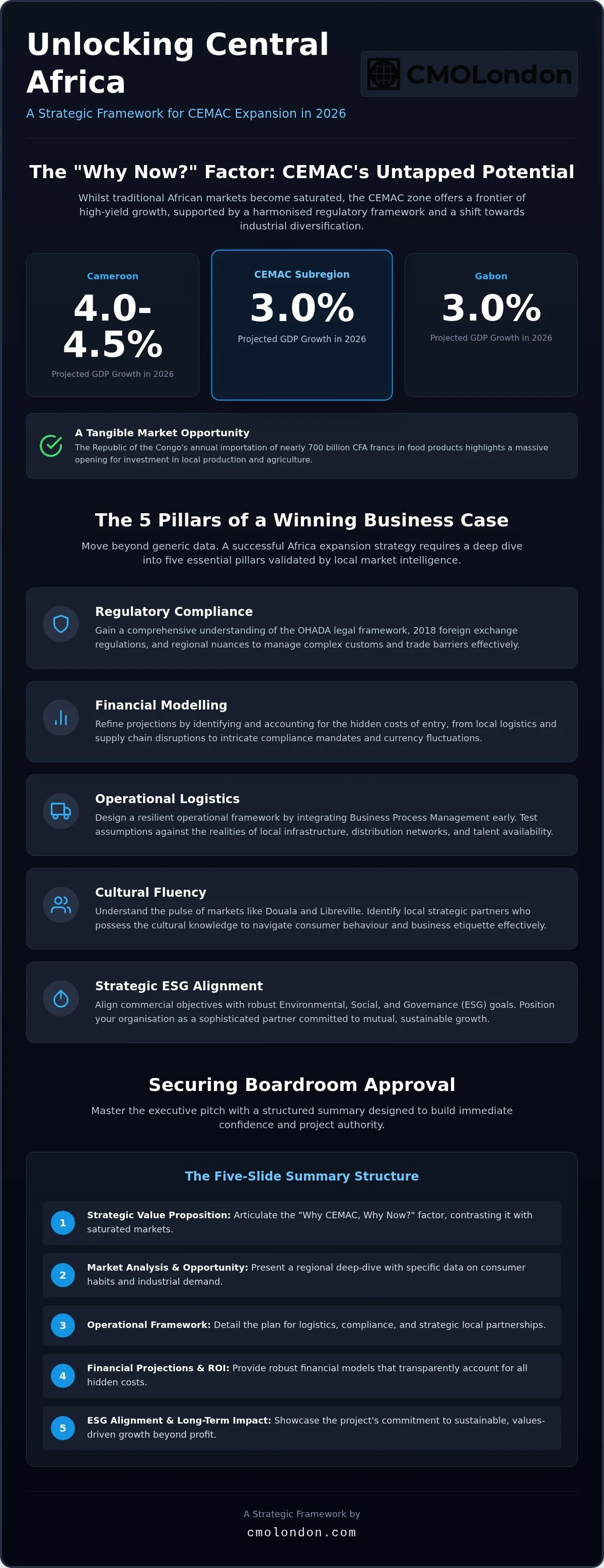
Timing is everything. With the Central Africa subregion projected to reach a GDP growth of 3.0% in 2026, the economic momentum is palpable. Cameroon is leading this charge with projected growth between 4.0% and 4.5%, whilst Gabon maintains a steady 3.0%. This isn't just about resource extraction; it's about a fundamental shift towards non-oil sectors. For instance, the Republic of the Congo currently imports nearly 700 billion CFA francs in food products annually, representing a massive opening for local production and agricultural investment. First-movers who establish their presence now will benefit from established relationships and market share before the window of opportunity narrows.
Aligning Expansion with Corporate ESG Goals
Modern boardrooms demand more than just profit; they require a commitment to sustainable impact. Central African expansion offers a unique opportunity to align commercial objectives with robust Environmental, Social, and Governance (ESG) goals. By integrating early childhood development initiatives and community-led infrastructure into your Africa expansion strategy business case, you position your firm as a sophisticated partner rather than a mere spectator. This values-driven approach builds the long-term trust necessary to navigate regional complexities. It transforms a market entry project into a legacy of mutual growth, ensuring your presence is welcomed by both regulators and the local populace alike.
Structuring the Market Entry Framework: Beyond Generic Data
Many organisations falter because they rely on aggregate data that masks the nuances of individual trade blocs. A winning Africa expansion strategy business case must pivot from a continental overview to a regional deep dive, specifically within the CEMAC zone. This shift ensures that your assumptions are tested against the realities of local logistics, consumer habits, and industrial demand. By moving beyond generic statistics, you provide your board with a narrative rooted in operational reality rather than speculative potential.
Integrating Business Process Management into your early planning allows for a more resilient operational design. It moves the conversation from a simple question of entry to a sophisticated discussion on excellence. Effective planning integrates five essential pillars: regulatory compliance, financial modelling, operational logistics, cultural fluency, and strategic alignment. Each pillar must be validated through local market intelligence to ensure that international assumptions don't collide with regional truths.
Phase 1: The CEMAC Market Intelligence Audit
Before drafting financial projections, you must conduct a rigorous intelligence audit. This involves more than just reading reports; it requires understanding the pulse of markets like Douala or Libreville. In Cameroon, for instance, consumer behaviour is heavily influenced by a growing middle class with a preference for high-quality, imported goods. Meanwhile, Gabon's industrial demand is shifting toward sophisticated infrastructure and energy services. You must identify key competitors and potential local strategic partners who possess the cultural fluency that outsiders often lack. Assessing the physical landscape is equally vital. The logistics of moving goods through the Port of Kribi differ significantly from the challenges found in landlocked member states like Chad or the Central African Republic.
Phase 2: Strategic Consulting and Model Selection
The choice of entry model is a critical pivot point in your expansion journey. Whether you opt for a direct entry, a joint venture, or a franchising model, the decision must be rooted in bespoke advisory rather than off-the-shelf templates. Strategic consulting management helps you weigh the benefits of 100% foreign ownership in Cameroon against the collaborative advantages of a local partnership in other member states. Cultural nuances often dictate the success of these models. For example, the pace of business negotiations in Central Africa rewards patience and long-term relationship building over aggressive, short-term transactional approaches. By selecting a model that respects these regional realities, you ensure your project direction remains steady and your stakeholders remain confident in the projected ROI.
Navigating Regulatory and Operational Intricacies in the CEMAC Zone
The success of a market entry project often hinges on how well a firm navigates the Organisation for the Harmonisation of Business Law in Africa (OHADA). This unified legal framework provides a level of predictability that is essential for any Africa expansion strategy business case. However, merely acknowledging the rules isn't enough. You must demonstrate a structural mastery that transforms these regulations from perceived barriers into strategic advantages. Professional Project Direction is indispensable here. It ensures that every stage of the rollout aligns with both regional mandates and your core commercial objectives.
Customs and trade barriers often represent the most significant operational hurdles. Mitigating these requires more than just paperwork; it demands strategic relationship management. By fostering transparent, long-term partnerships with local authorities, firms can navigate the intricacies of the CEMAC zone without the delays that typically plague outsiders. This proactive approach addresses the primary boardroom objection regarding political risk, replacing uncertainty with a controlled, methodical execution plan. Structural mastery is the antidote to volatility.
Mastering the Regulatory Landscape
UK firms entering the CEMAC region face a unique set of compliance requirements, particularly regarding local employment laws and business registration. For example, whilst Cameroon allows for 100% foreign ownership in most sectors, navigating the specific job creation commitments required for tax holidays requires nuanced local knowledge. Having a bridge-builder who possesses deep cultural and linguistic fluency allows you to interpret these mandates accurately. This ensures your registration process is not just a checkbox exercise but a foundational step in building local legitimacy and trust.
Operational Efficiency and Risk Mitigation
Implementing robust Business Process Management is essential for maintaining oversight of remote operations. This is particularly true when managing the financial complexities of the region, such as the 2018 CEMAC foreign exchange regulations. All foreign direct investment and proceeds must be declared to the Bank of Central African States (BEAC). Strategic planning for an Africa expansion strategy business case must also account for capital repatriation and currency fluctuations to protect your ROI. By building a resilient supply chain that leverages regional infrastructure, such as the special economic zones being developed in Chad, you can ensure your operational footprint is both stable and scalable.
Modelling Financial Projections and ROI for High-Growth African Markets
Traditional financial models often falter in Central Africa because they fail to account for the "complexity premium" required to operate within the CEMAC zone. A sophisticated Africa expansion strategy business case must look beyond standard five-year projections to present a Complexity-Adjusted ROI. This approach acknowledges that whilst growth rates in Gabon or Cameroon are attractive, the timeline for capital repatriation and the costs of compliance require a more nuanced perspective. By quantifying these regional variables, you provide your board with a grounded roadmap that balances ambitious growth with realistic operational expectations.
Identifying hidden costs early is a hallmark of strategic mastery. These expenses frequently include bespoke customs brokerage fees, compliance mandates for BEAC declarations, and the enhanced local logistics required for last-mile delivery in developing infrastructure. In the African context, professional project oversight acts as a critical financial safeguard, preventing the cost overruns that typically stem from regulatory delays or logistical bottlenecks. Meticulous project direction ensures that operational inefficiencies don't erode profit margins, directly safeguarding the bottom line in the intricate Central African market.
Revenue Forecasting in Emerging Economies
Projecting revenue in the CEMAC region requires a dual focus on market volatility and long-term industrial shifts. In 2026, high-margin opportunities are emerging in non-oil sectors, such as sustainable tourism and agricultural processing. For instance, modelling the impact of the Republic of the Congo's 700 billion CFA franc food import market allows firms to forecast the value of local production initiatives. Investors should also factor in regional fiscal updates, such as the 2026 reduction in Chad's withholding tax on capital income from 18% to 15%, which directly improves the net return on investment for non-resident entities.
Cost Management and Project Oversight
The financial difference between professional project direction and an unguided entry is often measured in months of saved operational time. Budgeting for local expertise and Strategic Consulting Management is not merely an expense; it's an investment in risk mitigation. These services ensure that your business case accounts for the 16.5% tax exemption on government securities currently available across the CEMAC zone, allowing for more efficient treasury management. Long-term value creation is achieved through sustainable business processes that prioritise local community development and linguistic fluency, ensuring your presence remains both profitable and culturally integrated for years to come.
Presenting the Business Case: Securing Board Approval with CMOLondon
The final threshold for any market entry is the boardroom. Even a data-rich Africa expansion strategy business case can falter if it lacks a narrative that bridges the gap between London-based strategy and Central African reality. Boards often harbour legitimate anxieties regarding market volatility and opaque regulatory environments. To secure approval, you must present a case that doesn't just acknowledge these risks but demonstrates a structural mastery over them. Positioning a partnership with a seasoned guide is the ultimate risk-mitigation strategy, transforming a daunting prospect into a controlled, high-yield opportunity.
Every successful executive summary for the CEMAC region should be distilled into five critical slides:
The Regional Strategic Opportunity: Identifying specific growth drivers in non-oil sectors across Gabon and Cameroon.
Structural and Regulatory Integrity: Demonstrating alignment with OHADA laws and regional BEAC mandates.
The Financial Roadmap: Presenting a complexity-adjusted ROI that accounts for regional nuances.
Operational Risk Mitigation: Outlining how local intelligence and linguistic fluency protect the firm's interests.
The Implementation Framework: A clear path from board approval to on-the-ground execution through professional oversight.
Communication Strategy for the Board
Success in the boardroom requires a shift from technical jargon to a "Wise Guide" narrative. By leveraging CMOLondon’s 12 years of specialist experience in the CEMAC zone, you provide stakeholders with the data-backed reassurance they require. It's about demonstrating that you possess rare, on-the-ground insights that outsiders typically lack. We act as the bridge between your London headquarters and the local authorities in Central Africa, ensuring that your global standards are never lost in local translation. This sophisticated approach builds immediate confidence and projects a sense of deep-rooted stability.
Next Steps: From Business Case to Project Direction
Transitioning from a business case to active implementation requires a shift in focus toward Project Direction. This stage is where strategic consulting management evolves into tangible operational outcomes. Planning is only the first step; the true value is realised through ongoing strategic oversight and the meticulous management of local business processes. For firms ready to access the high-growth potential of the CEMAC region, the path forward is clear. It involves moving with purpose, backed by an elite expert who has already navigated the difficult paths you are about to tread. Secure your market position for 2026 by turning your business case into a legacy of regional success.
Mastering the Frontier of Central African Growth
Navigating the high-growth markets of Gabon, Cameroon, and the wider CEMAC zone requires a departure from traditional, broad-scale thinking. By prioritising regional operational mastery and a complexity-adjusted financial outlook, you transform a speculative venture into a robust commercial reality. A winning Africa expansion strategy business case is not merely a document; it's a statement of intent that demonstrates your firm's readiness to bridge the gap between global standards and local intricacies.
Securing boardroom confidence depends on your ability to present a roadmap that is as realistic as it is ambitious. With over 12 years of specialist experience in Central African market entry, CMOLondon serves as the essential bridge between London-based strategy and on-the-ground execution. Our UK-based strategic consulting provides the deep regional mastery and cultural fluency required to lead your market entry project toward sustainable success. Secure your board approval with expert CEMAC strategy from CMOLondon and lead your organisation into a new era of prosperity. The potential of the Central African subregion is vast, and with the right guidance, your path to entry will be both clear and rewarding.
Frequently Asked Questions
What are the primary benefits of the CEMAC economic zone for UK investors?
The CEMAC region offers a harmonised monetary policy and a unified currency, the CFA franc, which provides a level of stability often missing in other emerging markets. UK investors benefit from a single legal framework through OHADA and the ability to access a market of six member states with reduced internal trade barriers. These factors create a predictable environment for long-term capital investment in sectors like sustainable tourism and agricultural processing.
How does OHADA law simplify business expansion in Central Africa?
OHADA provides a modern, uniform set of business laws across 17 African nations, including all CEMAC member states. It simplifies expansion by ensuring that commercial contracts, company registrations, and debt recovery processes follow the same rules regardless of the specific country. This legal harmonisation reduces the cost of entry and provides international stakeholders with a familiar, high-level legal structure that protects their commercial interests and intellectual property.
What are the biggest risks in an Africa expansion strategy business case?
The primary risks involve currency fluctuation, regulatory misunderstandings, and logistical bottlenecks at regional ports. A robust Africa expansion strategy business case must also account for the "complexity premium" of operating in markets with evolving compliance mandates. Managing these risks requires a shift from generic data to on-the-ground intelligence. This ensures that your ROI projections remain realistic whilst accounting for the specific operational challenges found in Gabon, Cameroon, or Chad.
How can a UK firm mitigate the lack of local market intelligence?
Mitigating a lack of intelligence requires partnering with a specialist bridge-builder who possesses deep cultural and linguistic fluency. CMOLondon provides the rare, on-the-ground insights necessary to validate international assumptions against regional realities. This approach allows UK firms to understand local consumer behaviour and industrial demand without the need for an immediate physical presence. Having a guide who understands the nuances of Douala or Libreville is essential for making informed, strategic decisions.
Why is the CEMAC region often overlooked compared to West or East Africa?
The region has historically been overlooked due to language barriers and a heavy reliance on the oil and gas sectors. Whilst English-speaking markets in East and West Africa often attract more initial attention, the CEMAC zone offers significantly less competition in emerging non-oil sectors. In 2026, the concerted effort to diversify economies in the Republic of the Congo and Gabon presents a unique window for first-movers to establish market dominance in untapped areas.
What role does project direction play in a successful market entry?
Project direction is the bridge between a high-level strategy and operational success. It ensures that every stage of the rollout, from business registration to supply chain integration, remains aligned with the firm's commercial objectives. In Central Africa, professional oversight is critical for navigating the 2018 CEMAC foreign exchange regulations and ensuring that local business processes are sustainable. It prevents the costly delays that often occur when international firms attempt to manage remote operations without specialist guidance.
How much should a firm budget for a Central African market entry audit?
Budgeting for a market entry audit depends on the complexity of the industry and the number of target countries within the CEMAC zone. A comprehensive audit should cover competitor analysis, consumer behaviour, and a deep dive into local logistics and infrastructure. Whilst costs vary, investing in high-quality market intelligence early in your Africa expansion strategy business case prevents expensive mistakes later. This investment ensures your financial roadmap is based on verified data rather than speculative assumptions.
Can CMOLondon assist with government relations in Gabon and Cameroon?
CMOLondon acts as a sophisticated bridge between London-based strategy and Central African execution, including facilitating transparent relationships with regional authorities. With over 12 years of experience, we help firms navigate the intricacies of local compliance and government mandates in Gabon and Cameroon. Our role is to ensure that your expansion aligns with national development plans, such as those in the Republic of the Congo, whilst building the long-term trust necessary for commercial success.